Medical Bill vs EOB: Check It Before You Pay
Before you start: This isn’t financial, legal or medical billing advice, and I’m not a billing expert. This sheet helps you put two papers side by side. Every rule below comes from CMS, HealthCare.gov, Medicare.gov or the CFPB, read November 19, 2026, with a link to each one.
Medical bill vs EOB: the bill comes from your doctor or hospital and asks for money. The Explanation of Benefits, or EOB, comes from your insurance and shows what they paid and what you owe. It isn’t a bill. Before you pay, match the two: same patient, same provider, same date, same services, and an amount due no higher than the EOB’s “what you owe.” If the bill is higher, call the billing office first.
I was diagnosed with ADHD at 46, so this post breaks the job into five small steps. You can stop after any of them.
There’s another reason to keep both papers. My husband’s union lets us send in some out-of-pocket costs for reimbursement, and every claim needs a copy of the receipt and the matching EOB. So for us, matching the bill to the EOB is also how we get money back. The phone call about this benefit sat on my to-do list for about three months. I wrote about why I kept moving it to next week over on Seeding Serendipity.
What’s the difference between a medical bill and an EOB?
The bill is from whoever gave the care. The EOB is from the plan that paid for part of it. CMS says it plainly: an explanation of benefits isn’t a bill. Here’s where the same facts show up on each one.
| What to match | On the bill | On the EOB |
|---|---|---|
| Who sent it | Your doctor, hospital or lab | Your health plan |
| Date of service | The visit date, near each charge | Date of service |
| Services | Each charge, sometimes as a billing code | Each service the plan processed |
| The full price | Charges or total charges | Provider charges |
| What the plan paid | Insurance payment or adjustment | Paid by insurer |
| What you owe | Amount due or balance due | What you owe, or patient balance |
| A reference number | Account number | Claim number |
The EOB has one more number to know, the allowed charges. CMS describes it as what your provider will be paid, and it can be lower than the full price on the bill. With an in-network provider, the gap is the discount your plan worked out, so you don’t owe it on top. Out of network, CMS says you might have to pay the difference, which it calls balance billing. The No Surprises Act blocks surprise out-of-network bills for emergency care and a few other cases, listed in the free help section below.
How do I check a medical bill against my EOB?
Five steps, one ticket each. Do them in order, and skip any you’re not ready for.
- Get both papers: the bill and the EOB for the same visit.
- Match who and when: patient, provider and date of service.
- Match the services: every charge is on the EOB, you got it, and it shows up once.
- Match what you owe: the amount due is no higher than the EOB says.
- Pay it or flag it: and write down which one you did.
Step 1: Which papers do I need?
Find the bill and the EOB with the same date of service. CMS says you should get the EOB from your plan before the bill arrives, so look in your mail and your plan’s app or website.
- Insurance through work or HealthCare.gov: the EOB.
- Two health plans, like yours and a spouse’s: you’ll get an EOB from each one. HealthCare.gov calls this coordination of benefits, the way two plans work out who pays first. Match the bill once both EOBs are in.
- Original Medicare: the Medicare Summary Notice. It comes every 6 months if you had any care, and it isn’t a bill either. On a Medicare Advantage or other Medicare health plan, use the EOB your plan mails each month you get care.
- A bill but no EOB yet: call your plan and ask whether the doctor’s office sent them a claim. CMS says to pay only after you get a bill, and the EOB is what tells you the bill is right.
- No insurance, or paying cash: use your good faith estimate instead. More on that in the FAQ below.
Step 2: Is it the same patient, provider and date?
Check the top of both papers. Same person, same doctor or hospital, same day of care. Use the date of service, not the date the bill was printed.
This step is fast and still catches things. A family member’s visit, a second doctor from the same practice, or a lab you never saw in person all show up as their own bill and their own EOB line.
Step 3: Is every charge on the bill also on the EOB?
Go down the bill one charge at a time. For each one, check three things: it’s on the EOB, you got it, and it’s only there once. The CFPB names being charged twice for the same service as a billing error to look for, and its older advisory adds care you never got, bills already paid, and wrong dates, medications or procedures.
Billing codes and short names are normal, so don’t panic at “99213.” Not sure is a fine answer. Mark it and keep going. If anything looks off, the CFPB’s advice is to ask for an itemized list of charges.
Step 4: Is the bill more than the EOB says I owe?
Find “amount due” on the bill and “what you owe” or “patient balance” on the EOB. CMS says your bill shouldn’t be higher than the patient balance, and if it is, talk to your provider.
Made-up example: the EOB says you owe $180 and the bill says $245.10. The bill asks for $65.10 more than your plan says you owe. That gap is why you call before you pay.
Paying from an HSA or FSA card? Match first. Getting money back after the fact is a bigger job than holding off a few days. If you’re paying it off over time, the yearly total goes on the annual bills planner.
Step 5: Pay it or flag it
If everything matched, pay it and write down four things: the date, the amount, how you paid, and the confirmation number.
If it didn’t match, call the billing office on the bill. Ask for an itemized bill and write down who you talked to, the date, a reference number and what they said. The phone call prep sheet keeps all of it on one page so the call doesn’t live in your head. Set a date to check back.
If the EOB shows a service was denied, that’s your plan’s call, not the doctor’s. HealthCare.gov says you have 180 days from the denial notice to file an internal appeal. If the plan still says no, you can ask for an external review within 4 months.
Either way, staple the bill, the EOB and the receipt together. That stack is what a reimbursement claim asks for, and it’s what you’ll want if the bill shows up again. The medical folder in the home filing system is a good place for it.
Check your bill with the Bill Match tool
Pick which papers you have, match who and when, list each charge, and type in the two amounts. The tool does the subtraction and tells you whether the bill is higher, lower or the same. It doesn’t tell you to pay or not.
What you type is saved in this browser only. There's no account, no login, and nothing gets sent anywhere. Don't type member ID numbers or Social Security numbers into it.
The printable medical bill vs EOB check
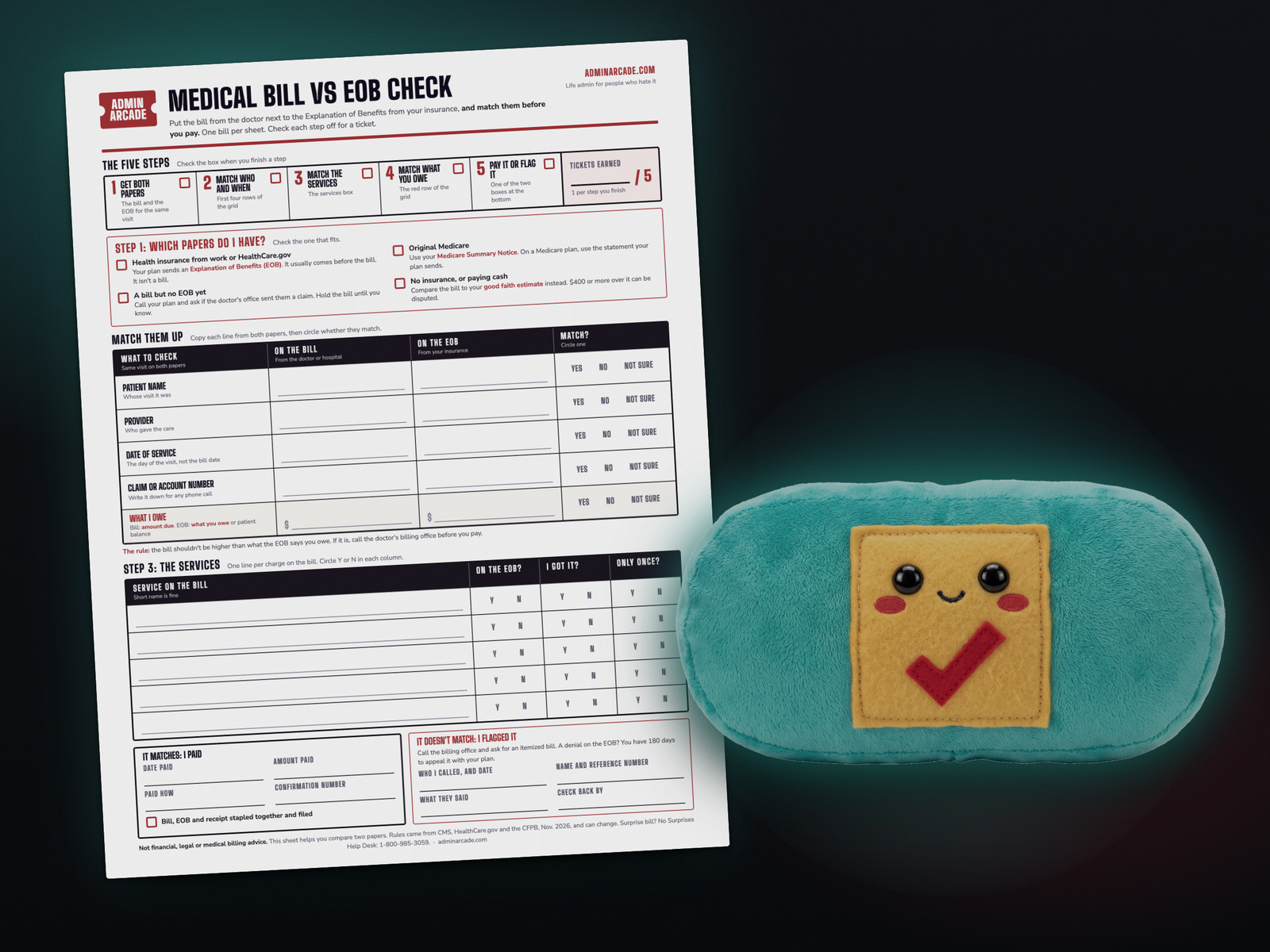
One page, free, no email required. It has the five steps with a check box each, a box for which papers you have, and a grid with a column for the bill, a column for the EOB and a Match column to circle. Below it there's a line for each charge, then two boxes at the bottom: one for when you paid, one for when you flagged it and called. Use one sheet per bill.
Two rules for medical bills
The EOB comes first. A bill without its EOB is a number without a reason. Wait for it, or call your plan and ask about the claim.
Keep both papers together. Bill, EOB and receipt, stapled. Reimbursement claims ask for it, and so does any phone call about the bill.
Finish all five steps and you've earned five tickets and Bandage Bea, the prize on this one. Nothing expires and there's no streak to lose, so a bill you start checking today and finish after the callback still pays the same five.

Where to get free help with a medical bill
- Your health plan: the member services number on your insurance card or the EOB.
- A surprise bill: the No Surprises Help Desk, 1-800-985-3059, open 7 days a week. The No Surprises Act, in effect since January 1, 2022, covers emergency care, care tied to a visit at an in-network hospital or surgery center, and air ambulance.
- Medicare: 1-800-MEDICARE (1-800-633-4227).
Not financial, legal or medical billing advice. I'm not a billing expert, and nothing here tells you whether to pay a specific bill. This sheet helps you compare the papers you already have. Rules and numbers came from CMS, HealthCare.gov, Medicare.gov and the CFPB on November 19, 2026, and can change. For your own bill, talk to your plan, the provider's billing office, or one of the free helpers above.
Frequently asked questions
Is an EOB a bill?
No. CMS says an explanation of benefits isn't a bill. It shows what was charged, what your plan paid and what you owe, and any amount you owe gets billed by the provider.
Should I pay a medical bill before I get the EOB?
CMS says you should get the EOB before the bill, and to pay only after you get a bill from the provider. If a bill shows up first, call your plan and ask whether the claim was sent, then match the two.
What if my medical bill is higher than the EOB?
CMS says the bill shouldn't be higher than the patient balance on your EOB. Call the provider's billing office before you pay, ask for an itemized bill, and write down who you talked to and a reference number.
How long do I have to appeal a denied claim?
HealthCare.gov says you have 180 days, or 6 months, from the denial notice to file an internal appeal with your plan. If the plan still denies it, you have 4 months to ask for an external review.
What if I don't have insurance?
Compare the bill to your good faith estimate. CMS says you can dispute a bill $400 or more over the estimate if it's dated within the last 120 days, and filing costs $25.
Is the medical bill vs EOB check free?
Yes, and there's no email required. The printable is one page, and the Bill Match tool on this post is free too.
A tool I built
Emergency Fund Aquarium
Log what you save at your own bank and watch your tank fill with creatures. Your money never moves through the app.
Start your tank →I run an affiliate program on the tools I build. Approved affiliates earn 20% on what their referrals pay, for up to a year. US only for now. See the program →