How Long to Keep Paperwork: Free Keep-or-Shred Sheet
How long to keep paperwork depends on what the paper is. The IRS says keep tax records for 3 years unless a longer rule applies, and keep copies of your filed returns. The FTC’s 2025 guide says keep bank statements, pay stubs and bills for a year, your car title while you own the car, and birth certificates and Social Security cards forever. Before anything goes in the shredder, check nothing else still needs it.
I come from people who keep paperwork
Not too long ago, my family found business paperwork from 1977 in the office of our family’s company. It was my Grampa’s. We kept it, of course.
I’m just like him. I have a ton of paperwork going back years and years. A lot of receipts and other papers of mine are in boxes, and there’s an embarrassing pile right next to me in need of an admin night or six.
Why do I keep it? Both reasons. I’m not sure what’s safe to shred, and I never get to it. I used to own a shredder, then I donated it, so now I rip things up by hand.
What I want to know is when it’s totally safe to shred. None of the official sources behind this post promise it’s safe. The IRS says don’t throw records away “until you check to see if you have to keep them longer for other purposes.” The answers also don’t agree with each other. The FTC’s 2022 guide said shred credit card and utility bills right after you pay them. Its 2025 guide says keep them a year.
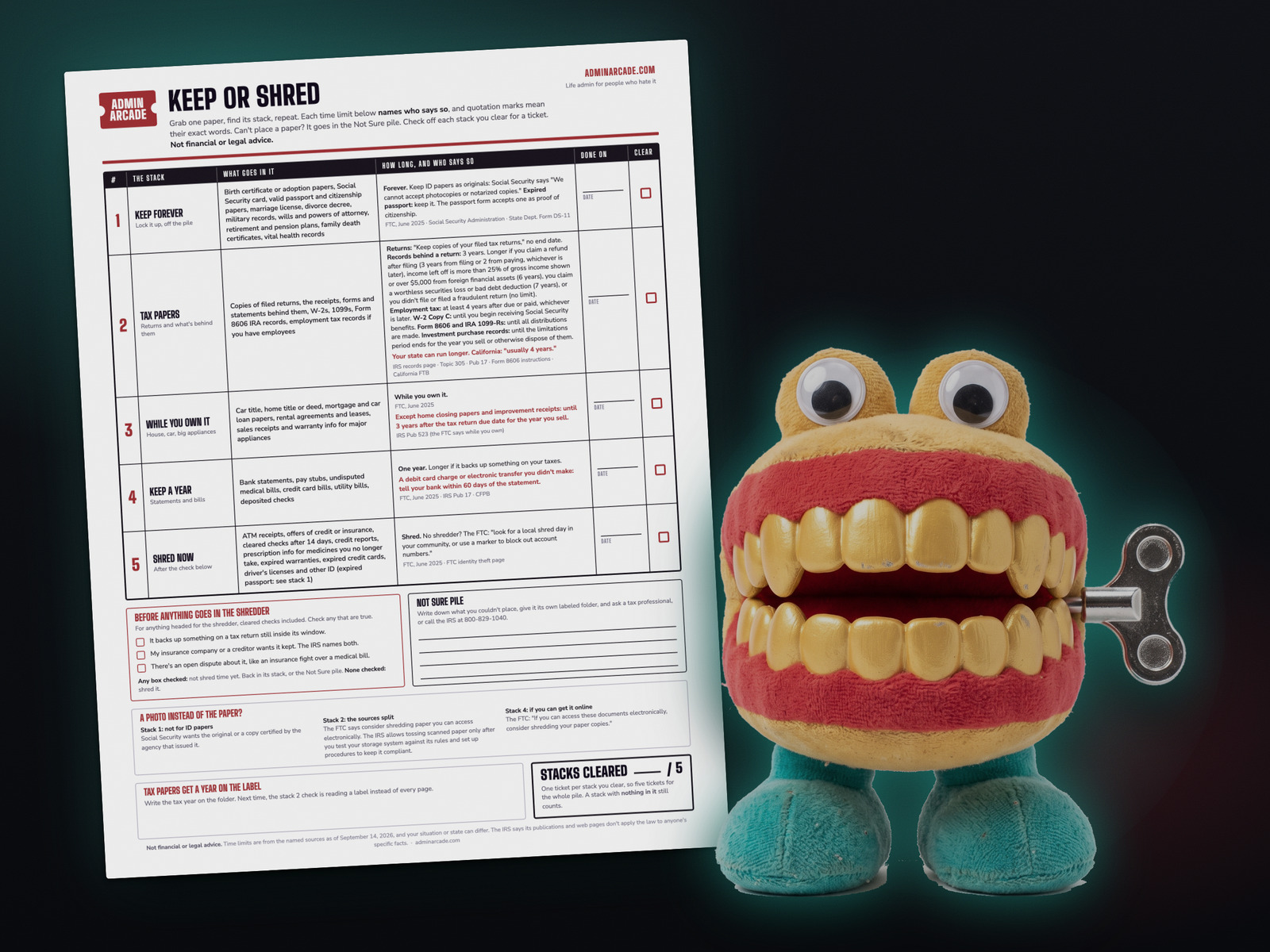
So this post gives the time limits in each source’s own words, sorted into five stacks. Grab one paper, find its stack, repeat. Each stack you clear is one ticket, and you can stop after any of them. Anything you can’t place goes in a Not Sure stack, and you move on.
Stack 1: Keep forever, and lock it up
The FTC’s 2025 list, under “Keep Forever / And lock up”:
- Birth certificate or adoption papers
- Social Security cards
- Valid passports and citizenship or residency papers
- Marriage licenses and divorce decrees
- Military records
- Wills, living wills, powers of attorney, and retirement and pension plans
- Death certificates of family members
- Vital health records, especially older ones from before electronic health records
For ID papers like a birth certificate, keep the original. The Social Security Administration asks for original documents or copies certified by the agency that issued them, and says, “We cannot accept photocopies or notarized copies.” For a will, the FTC says, “ask your attorney to keep the original.” An expired passport stays in this stack too. The State Department’s passport application accepts one as proof of citizenship: “Fully valid, undamaged U.S. passport (may be expired).” I keep my passports and certificates in a fireproof document bag with a lock.
Stack 2: How long to keep tax papers
Bank of America, American Express and Capital One all give seven years for tax paperwork, and Bank of America says, “Generally, this is the period that the IRS has to examine your return.” The IRS’s own records page says keep records for 3 years unless one of its longer situations applies:
| Your situation | Keep the records behind the return |
|---|---|
| None of the ones below | 3 years |
| You file a claim for a credit or refund after filing | 3 years from filing, or 2 years from paying the tax, whichever is later |
| Income left off the return is more than 25% of the gross income shown on it, or is from foreign financial assets and over $5,000 (per IRS Tax Topic 305) | 6 years |
| You file a claim for a loss from worthless securities or a bad debt deduction | 7 years |
| You didn’t file, or filed a fraudulent return | Indefinitely |
| You have employees (employment tax records) | At least 4 years after the tax is due or paid, whichever is later |
Unless a row says otherwise, the IRS counts from when you filed, and an early return counts as filed on the due date. A few papers follow their own rules:
- The returns themselves: the IRS says, “Keep copies of your filed tax returns,” and gives no end date. A copy from the IRS costs $30 per return on Form 4506, and it says copies of Form 1040 are “generally available for 7 years from filing.”
- W-2s: IRS Publication 17 says to keep Copy C “until you begin receiving social security benefits.”
- IRA records: the Form 8606 instructions say to keep the forms that show the nontaxable part of IRA distributions “until all distributions are made.”
- Your state: it can run longer. California’s Franchise Tax Board says its window is “usually 4 years.” Minnesota’s Department of Revenue says 3½ years.
If you have side hustle papers in here, the side hustle income log has a 1099 folder for them. I track my own business spending in an Airtable base shaped like the Schedule C.
Stack 3: Keep while you own it
The FTC’s 2025 “Keep While You Own” list: your vehicle title, the title or deed to your home, mortgage or vehicle loan documents, rental agreements and leases, and sales receipts and warranty information for major appliances.
One big exception, where the FTC and IRS disagree: the papers showing what your home cost. IRS Publication 17 says those records should show “the purchase price, settlement or closing costs, and the cost of any improvements.” Publication 523 says to keep them “until 3 years after the due date for your tax return for the year in which you sold your home.” So closing papers and improvement receipts stay after the sale.
Investments follow the same IRS idea. Keep records relating to property “until the period of limitations expires for the year in which you dispose of the property.”
Stack 4: Keep for a year
The FTC’s 2025 “Keep for a Year” list: bank statements, pay stubs, undisputed medical bills, credit card and utility bills, and deposited checks.
A year for bank statements felt short to me too. It’s the same number from the FTC, Bank of America, American Express, Capital One and BECU, a credit union. Here’s when a statement stays longer, or needs a look sooner:
- It backs up something on your taxes. IRS Publication 17 says a bank statement can prove a payment, so a statement behind a deduction moves to Stack 2. Same for a year-end pay stub showing deductible expenses taken out of your paycheck.
- A debit card charge or other electronic transfer on it is wrong. Read each statement when it arrives. For those, the Consumer Financial Protection Bureau says you “must notify your bank within 60 days” after it sends the statement showing the unauthorized transaction.
- You’re closing the account. U.S. Bank, for its own accounts, says digital statements “are no longer available through online and mobile banking” once an account is closed. Download what you want first.
Federal rules (31 CFR 1020.410 and 1010.430) require banks to keep each statement or record on a deposit account for five years. Those rules don’t say the bank has to hand you a copy of a statement.
Stack 5: Shred now, after one last check
The FTC’s 2025 “Shred” list: ATM receipts, offers of credit or insurance, cleared checks after 14 days, credit reports, prescription information for medicines you no longer take, expired warranties, and expired credit cards, driver’s licenses and other ID. The FTC’s list doesn’t name passports, and an expired one stays in Stack 1.
Anything from Stacks 2 through 4 whose time is up joins it. Everything headed for the shredder gets three questions first, cleared checks included, because the FTC’s own tax list names canceled checks. If any answer is yes, it isn’t shred time yet:
- Does it back up something on a tax return still inside its window?
- Does your insurance company or a creditor want it kept? The IRS names both.
- Is there an open dispute about it, like an insurance fight over a medical bill?
Then shred it. For those of us without a shredder, the FTC says, “look for a local shred day in your community, or use a marker to block out account numbers.”
Can you take a photo and toss the paper?
It depends on the stack.
- Stack 1, no for ID papers. Social Security wants the original or a copy certified by the agency that issued it, and the passport application asks for “an original or certified copy” plus a photocopy.
- Stack 2, this is where sources split. The FTC’s “Keep for at Least Three Years” list, which covers income tax returns, tax-related documents and records related to selling a home, ends with the same line as Stack 4 below, to consider shredding paper you can access electronically. The IRS is stricter about your own scans. Under Revenue Procedure 97-22, paper can be destroyed only after you’ve tested your storage system against all its rules, including an index and legible copies, and set up procedures to keep it compliant. None of the IRS record-keeping pages checked for this post say a phone photo of a receipt counts.
- Stack 4, if you can get it online. The FTC says, “If you can access these documents electronically, consider shredding your paper copies.” It says nothing about photos you take yourself.
If you do keep digital copies, the FTC says to make sure access “requires a strong password and multifactor authentication.”
Sort a paper with Keep or Shred
Pick what the paper is, and Keep or Shred tells you its stack, the time limit in the source’s words, who said it, and where sources disagree.
Nothing you pick leaves your browser. There's no account and no server behind it. Not financial or legal advice.
The printable keep-or-shred sheet
One page, free, no email required. The five stacks with what goes in each and how long, the three questions to ask before you shred, a Not Sure box, and a check box and ticket line per stack.
Two rules so the pile stays smaller
Not Sure gets its own folder. Label it, and ask a tax pro or call the IRS at 800-829-1040. The IRS lists those hours as 7 a.m. to 7 p.m. local time, and says Alaska and Hawaii should follow Pacific time.
Tax papers get a year on the label. Next time, the Stack 2 check is reading a label instead of every page.
Clear all five stacks and you've earned five tickets and Shreddy Eddie. Nothing expires and there's no streak to lose, so a pile you sort a stack at a time over six admin nights still pays the same five.

Not financial or legal advice. Every time limit above comes from a named government agency, federal rule, bank or credit union, as of September 14, 2026, and the words in quotation marks are theirs. The IRS says its own publications and web pages don't apply the law to anyone's specific facts. If you're not sure, ask a tax professional before you shred.
Frequently asked questions
How long should I keep tax returns?
Keep copies of your filed returns. The IRS says "Keep copies of your filed tax returns" and gives no end date. The records behind a return follow the IRS periods, which start at 3 years and run longer in specific situations.
How long should I keep bank statements?
A year, according to the FTC, Bank of America, American Express, Capital One and BECU. Keep one longer if it backs up something on your taxes.
Do I need to keep tax records for 7 years?
Not unless a longer rule applies to you. The IRS records page says 3 years by default, with longer periods for specific situations like leaving income off a return or claiming a loss from worthless securities. Some papers follow their own, longer rules: records of what your home or investments cost, Form 8606 IRA records, W-2 Copy C, and copies of your returns.
Can I keep a photo of a document instead of the paper?
For bank statements and bills you can access online, the FTC says to consider shredding the paper. For a birth certificate or Social Security card, keep the original, because Social Security accepts only originals or copies certified by the issuing agency.
What if I don't have a shredder?
The FTC says to look for a local shred day in your community, or use a marker to block out account numbers.
Is the printable keep-or-shred sheet free?
Yes, and there's no email required to get it.
A book I made
The Lightest One
An undated ADHD daily book that never asks you to prioritize. Dump everything in your head, mark each thing light, medium or heavy, and do the lightest one.
Get the paperback →I run an affiliate program on the tools I build. Approved affiliates earn 20% on what their referrals pay, for up to a year. US only for now. See the program →