Free Printable Pet Records Sheet: Vet, Vaccines, Microchip
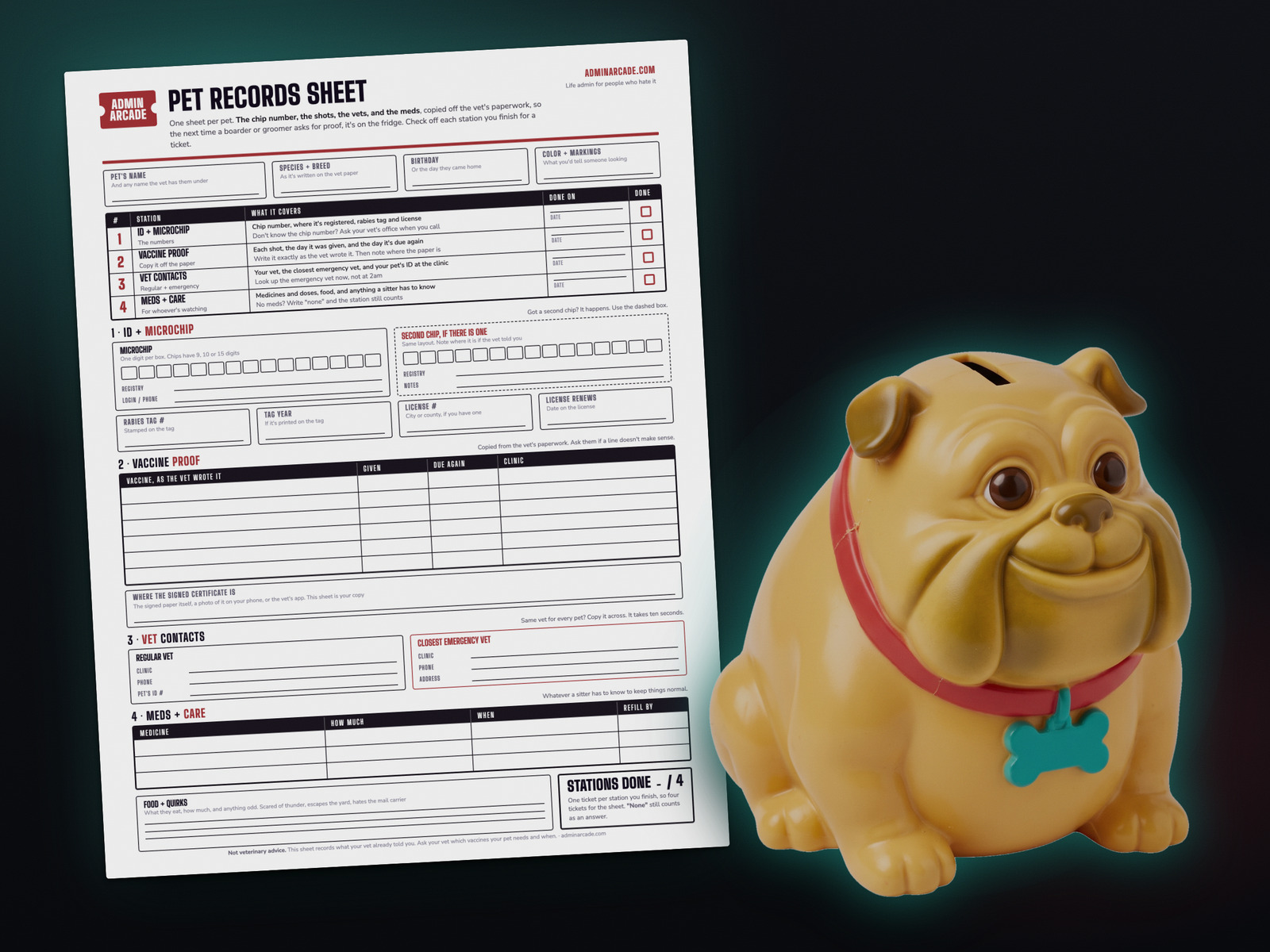
A printable pet records sheet is one page per pet with the microchip number and its registry, the rabies tag number, every vaccine with the date it was given and the date it’s due again, your regular and emergency vet, and any meds. Copy it off the vet’s paperwork once. The next time a boarder, groomer or sitter asks for proof, you’ll know where it is instead of calling the vet.
The time I couldn’t find my dog’s vaccine records
This was a long time ago, because we haven’t left our pets in over a decade. But we went on a trip and boarded a dog, and to board them, you had to show proof of vaccinations.
I couldn’t find them anywhere. So I called the vet and got them. It was doable, but it was a pain.
Our pet records are in a very messy filing cabinet, possibly not even in the correct folders. If someone asked me for proof today, it would be easier to just call the vet again.
The microchips are the same story. All my dogs are chipped, and I have no idea what the numbers are or where they’re registered. I’d have to call the vet for those too.
What goes on a printable pet records sheet?
Four stations, one ticket each. Do one pet or all of them, and stop after any station.
- ID and microchip: the chip number, where it’s registered, the rabies tag and any license.
- Vaccine proof: each shot, the date it was given, the date it’s due again, and where the signed paper is.
- Vet contacts: your regular vet, the closest emergency vet, and your pet’s ID at the clinic.
- Meds and care: medicines and doses, food, and what a sitter has to know.
You copy all of it from paperwork you already have. Which vaccines your pet needs, and when, is your vet’s call, so the dates on their paper are the ones to write down.
Station 1: Your pet’s microchip number, registry and rabies tag
According to the AVMA’s microchipping FAQ, chip numbers are 9, 10 or 15 digits long, and chips built to the international standard use 15. The printable has 15 boxes, so a shorter number leaves a few empty.
Next to the number goes the registry. The AVMA says a chip “needs to be registered with the microchip manufacturer or registry” to do its job, and the U.S. has no single central database. Not sure where yours is registered? Type the number into AAHA’s microchip lookup. It points you to the registry to call, and it doesn’t show owner contact details.
Got two chips? It happens. One of my dogs has two, because his first one migrated into his shoulder and they had to put in another. That’s another story. The AVMA lists migration as the most reported microchip issue and says it can make a chip harder to find without a complete scan. The sheet and the tool both have room for a second chip.
Then the number on the rabies tag, and your city or county license number if you have one. The AVMA says to keep the rabies tag on the collar so others can quickly see your pet has been vaccinated.
Station 2: How do I get proof of my pet’s vaccinations?
Grab the last vet receipt or certificate and copy each vaccine line exactly as the vet wrote it, even if it’s a string of letters. Write the date it was given and the date it’s due again. Ask the vet’s office about any line you can’t read.
Then write down where the signed paper itself lives. The sheet is your copy. Whoever asks for proof wants the paper, a photo of it, or a copy from the vet. For me, that’s the messy filing cabinet.
Can’t find the paper at all? Ask for a copy. The AVMA’s ethics principles say “a veterinarian is obligated to provide copies or summaries of medical records when requested by the client.” Take a photo of it the day it shows up.
The due-again dates are the ones to keep an eye on. If you already keep an appointment tracker, add the next vaccine date to it as a vet visit, so it shows up with everything else coming up.
Station 3: Which vets go on a pet records sheet?
Write down your regular vet’s name and number, and your pet’s ID number at the clinic if it’s printed on your receipt.
Then look up the closest emergency vet and write down the name, phone and address. Look it up on a normal Monday, while nothing’s wrong, and not at 2am. If you have the who to call fridge sheet, the vet goes on there too.
Station 4: Meds and care notes for a sitter
List each medicine with how much and when. Then food, how much, and how often. Then the quirks: scared of thunder, escapes the yard, hates the mail carrier. Anything a sitter has to know to keep the day normal goes here.
No meds? Leave it empty and the station still counts. If you’re leaving the pets with someone, this page goes in the pile with your before-you-leave list. And if you’d like a card in your wallet telling people you have pets at home, the emergency wallet card has a pets line for it. We usually bring the pets instead, and their stuff rides in the bag from my Rubyloo dog travel bag review.
Fill it in with the pet records tool
The tool walks the same four stations. Add each pet, fill in the numbers, add each vaccine with its dates, and it sorts the shots by due date so you see what’s coming up first. At the end you can print one page per pet, or save the print as a PDF to keep on your phone.
Your records save in your own browser, so you can come back on the same device. There's no account and no server behind it, and "Delete my records" wipes it.
The printable pet records sheet
One page per pet, free, no email required. Name, breed, birthday and markings at the top, the four stations with a date line and a box each, 15 boxes for the chip number plus a dashed box for a second chip, 6 vaccine rows, both vets, 3 med rows, and room for food and quirks. Print one for each pet and put them on the fridge.
Two rules to keep pet records findable
Copy it the day the paper comes home. After every vet visit, the new dates go on the sheet before the receipt goes anywhere.
Keep a photo with the sheet. Snap the signed certificate on your phone. The sheet tells you what's due, and the photo is the proof someone asks for.
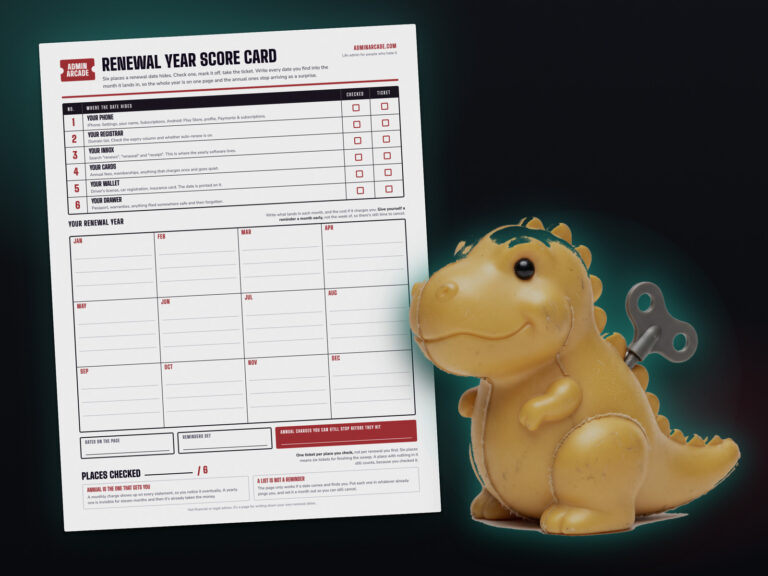
Finish all four stations and you've earned four tickets and Kibble Kenny, the prize on this one. Nothing expires and there's no streak to lose, so a sheet you start tonight and finish after the next vet visit still pays the same four.

Not veterinary advice. This sheet records what your vet already told you. Ask your vet which vaccines your pet needs and when.
Frequently asked questions
How many digits is a pet microchip number?
The AVMA says pet microchip numbers are 9, 10 or 15 digits long. Chips built to the international ISO standard use 15 digits. Copy every digit off the paperwork, and ask your vet if the count doesn't match.
How do I find out where my pet's microchip is registered?
Type the chip number into AAHA's microchip lookup at petmicrochiplookup.org. It points you to the registry, and it doesn't show owner contact details. Don't have the number? Ask your vet's office.
How do I get proof of my pet's vaccinations?
Ask your vet for a copy. The AVMA's ethics principles say a veterinarian is obligated to provide copies or summaries of medical records when the client asks. Keep a photo of the signed paper on your phone.
Can a pet have two microchips?
Yes. One of my dogs has two, because his first chip migrated into his shoulder and the vet put in another. The AVMA lists migration as the most reported microchip issue. Write both numbers down.
Is the printable pet records sheet free?
Yes, and there's no email required to get it. Print one page for each pet.
A tool I built
Emergency Fund Aquarium
Log what you save at your own bank and watch your tank fill with creatures. Your money never moves through the app.
Start your tank →I run an affiliate program on the tools I build. Approved affiliates earn 20% on what their referrals pay, for up to a year. US only for now. See the program →