Free Printable Wallet Card: Meds, Allergies, Who to Call
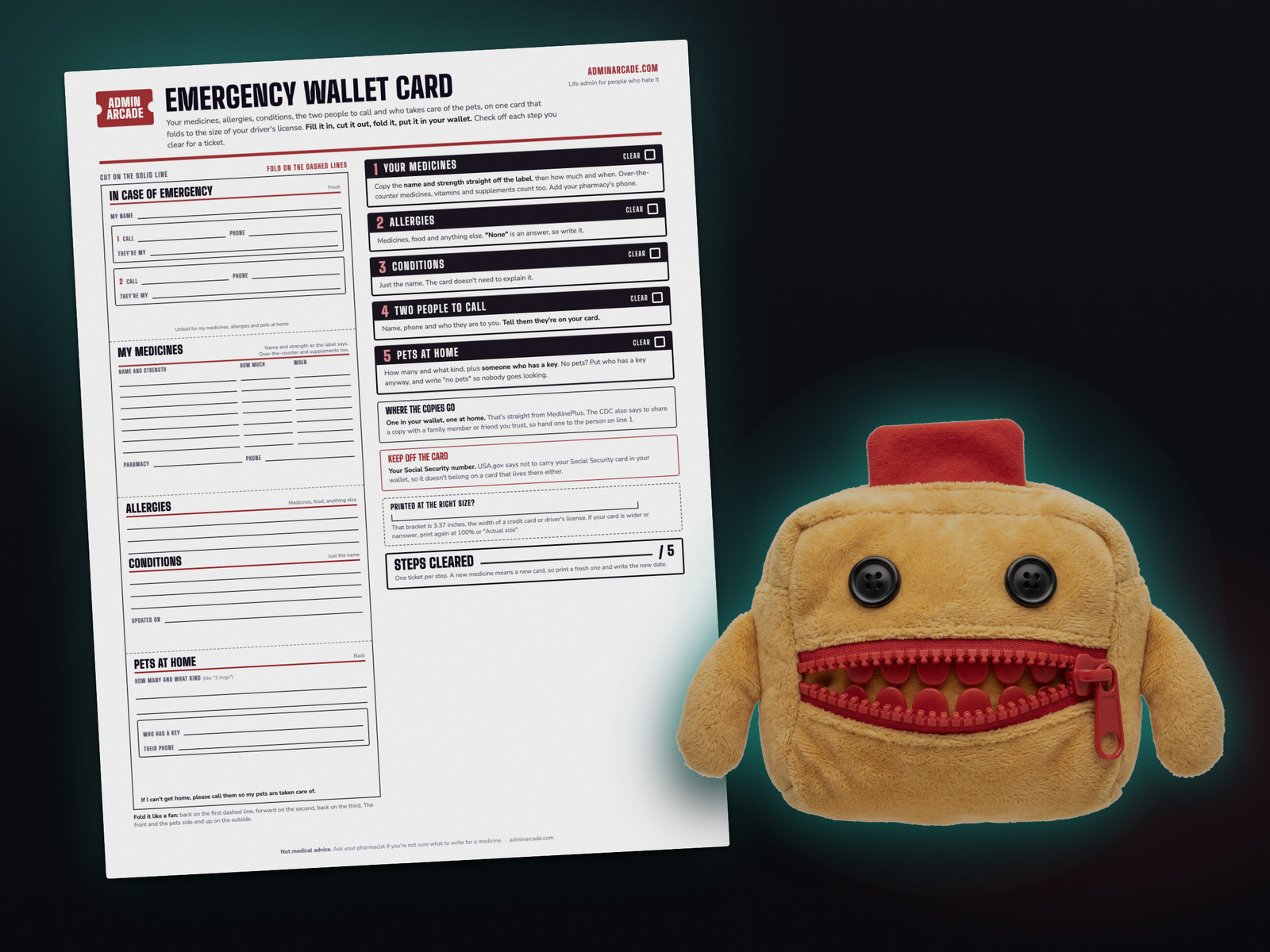
A printable wallet card holds what a care team and your people need if you can’t tell them yourself: your medicines as the label says, allergies, conditions, two people to call, and who takes care of the pets at home. Fill it in, cut it out, and fold it to the size of a driver’s license. Keep a copy at home too, and leave your Social Security number off it.
Why I made an emergency wallet card
This hasn’t happened to me. It’s a fear.
I’m also afraid that if something happens, my 3 dogs will be home alone.
Before my surgery, I wrote all our accounts in a notebook for my husband, and it’s in our safe. That notebook is where the printable account list starts. A notebook in a safe doesn’t help anyone at a hospital, though, and it doesn’t get anyone to my dogs.
What I want out of it is peace of mind. Someone I trust gets called, my pets get taken care of, and the care team has my information.
Filling it in is the part you can do. The bracing that comes before it is a different problem, and I wrote about how to stop waiting for the other shoe to drop over on my other blog.
Five steps, one ticket each. Stop after any of them and the card still has more on it than your wallet does right now.
Step 1: Copy your medicines straight off the label
Get the bottles out and copy them. Don’t write them from memory. The Connecticut Department of Public Health’s wallet card says to “copy the name of the medicine and amount from the label on the medicine bottle or other container (for example, aspirin 40 mg),” then write how much you take each time and how many times a day.
Over-the-counter counts. The FDA’s medicine record says to enter “ALL over-the-counter medicines and dietary supplements (including vitamins, minerals, and herbals) you use, whether you use them all the time or only some of the time.” MedlinePlus says the same about vitamins, supplements and herbal products.
Add your pharmacy’s name and phone at the bottom. The Connecticut card asks for it so healthcare workers can “figure out who to call with questions about your medicines if you can’t answer questions.” If you already keep the appointment and refill tracker, the pharmacy number is already on it.
Step 2: List your allergies, even if it’s “none”
The Connecticut card says to “List all allergies that you have, including allergies to medicines and to food.” The FDA’s form goes wider and asks about reactions to “any medicine, dietary supplement, food, skin cleaner, medical tape.”
No allergies? Write “none.” A blank line doesn’t tell anyone whether you checked.
Step 3: Write down your conditions, name only
Just the name of each one. The card doesn’t need to explain it, and there isn’t room anyway.
The Connecticut card’s examples are useful for jogging your memory: “any conditions you have (such as diabetes or high blood pressure) or if you have a pacemaker or have had a knee or hip replaced.” So an implant or a replaced joint goes here too.
Step 4: Pick two people to call, and tell them
The front of the card is your name and two people, each with a phone number and who they are to you.
The ASPCA’s Pet Alert Card lists “two emergency contacts,” and the Town of Palm Beach’s In Case of Emergency program in Florida says to pick “two or three people” and “confirm that they agree to respond if needed.”
So call them. It’s a short conversation: you’re on my card, here’s what’s on it. The same people probably belong on the who-to-call sheet on your fridge.
Step 5: Pets at home, and who has a key
This is the step for my 3 dogs.
The ASPCA describes a Pet Alert Card as one “you can carry in your wallet” that “will alert authorities that you have a pet at home.” The Connecticut Humane Society says to carry one “in your wallet or on your keychain,” with the contact information for your emergency pet caregivers.
A phone number alone doesn’t feed a dog, though. The Humane Society of Mason County in Washington says your caregiver “will need access to your home,” whether that’s a key, a garage code or another system. That’s why the back of this card has a line for who has a key, not just who to call.
Write how many pets and what kind, like “3 dogs,” then the person with a key and their phone. No pets? Put who has a key anyway and write “no pets,” so nobody goes looking. On trips, we usually bring the pets or I don’t go, which is on the before-you-leave list.
What should you leave off a wallet card?
Your Social Security number. USA.gov says to store your Social Security card in a safe place and “Do not carry it in your wallet.” The IRS says not to routinely carry “your card or other documents that display your number.” A wallet card with your number on it is one of those documents.
Your Medicare card is different. Medicare.gov says its number is “not your Social Security Number,” and if you have Original Medicare, it says to “Carry your Medicare card with you when you’re away from home.” If you have a Medicare Advantage plan, it says you’ll use the plan’s card instead.
| Card | Carry it? | What the agency says |
|---|---|---|
| Social Security card | No | USA.gov says to store it in a safe place and not carry it in your wallet |
| Original Medicare card | Yes | Medicare.gov says to carry it with you when you’re away from home |
| Medicare Advantage plan card | Yes, instead of the Medicare card | Medicare.gov says you’ll use the plan’s card instead |
How do you put medical info on your phone’s lock screen?
- iPhone: Apple says Medical ID lets first responders see “information like allergies and medical conditions as well as who to contact in case of an emergency” from the Lock screen without your passcode. Turn on Show When Locked.
- Android: Google says you can add “your blood type, allergies, and medications” to the lock screen, and “Anyone who picks up your phone” can see it. Some of the steps only work on Android 12 and up.
The card works if your phone is dead or lost. The phone works if your wallet isn’t on you.
Fill in your card with Wallet Card
Wallet Card walks the same five steps, shows the card filling in as you type, and prints it at actual size with the fold lines on it. Typed text fits a card this small better than handwriting.
Nothing you type leaves your browser or gets saved, and there's no account, so print the card before you close the page.
What's on the printable wallet card?
One page, free, no email required. The card is four panels, each 3.37 by 2.125 inches, the size of a credit card or driver's license:
- Front: your name and the two people to call
- Inside: seven lines for medicines plus the pharmacy, then allergies, conditions and the date you updated it
- Back: pets at home and who has a key
Print at 100% or "Actual size." The sheet has a 3.37-inch bracket so you can check it against a card in your wallet. Cut on the solid line and fold on the dashed lines like a fan, and the front and the pets side end up on the outside.
Two rules so the card stays right
A new medicine means a new card. None of the sources here give a fixed schedule. The FDA says to update your medicine record when you "Stop or start a medicine or dietary supplement" and when you visit your doctor or pharmacist, so write the date on it each time.
One in your wallet, one at home. MedlinePlus says to "Keep a copy of the list in your wallet and at home." The CDC's disaster advice says to share a copy with "a trusted family member or friend," so person 1 on your card gets one too. Mine goes in the safe with the account notebook. A lockbox or a fireproof document holder does the same job, as long as the person on your card knows where it is.
Clear all five steps and you've earned five tickets and Wally Wallet, the prize on this one. Nothing expires and there's no streak to lose, so a card you start today and finish next week still pays the same five.

Not medical advice. Every outside recommendation above is attributed by name to the agency, program or company that published it. Ask your pharmacist if you're not sure how to write down a medicine.
Frequently asked questions
What should be on an emergency wallet card?
Your medicines as the label says (name, strength, how much and when), allergies, conditions, one or two people to call, and your pharmacy's phone. The Connecticut Department of Public Health's wallet card asks for all of those. If you have pets, add that they're home and who has a key.
Should I carry my Social Security card in my wallet?
No. USA.gov says to store your Social Security card in a safe place and not carry it in your wallet, and the IRS says not to routinely carry documents that display your number. Leave it off your wallet card too.
Should I carry my Medicare card?
If you have Original Medicare, yes. Medicare.gov says to carry your Medicare card when you're away from home, and its number isn't your Social Security number. With a Medicare Advantage plan, Medicare.gov says you use your plan's card instead.
What is a pet alert card?
A pet alert card tells whoever finds it that you have pets at home. The ASPCA says its Pet Alert Card fits in your wallet and lists two emergency contacts who can be notified if something happens to you. This printable puts the pets and who has a key on the back of your wallet card.
How often should I update my emergency wallet card?
Update it whenever a medicine changes. The FDA says to update your medicine record when you stop or start a medicine or supplement and when you visit your doctor or pharmacist. Write the date on the card each time.
Is the printable wallet card free?
Yes, and there's no email required to get it.
A tool I built
Emergency Fund Aquarium
Log what you save at your own bank and watch your tank fill with creatures. Your money never moves through the app.
Start your tank →I run an affiliate program on the tools I build. Approved affiliates earn 20% on what their referrals pay, for up to a year. US only for now. See the program →