Who to Call When Something Breaks: Free Printable Sheet
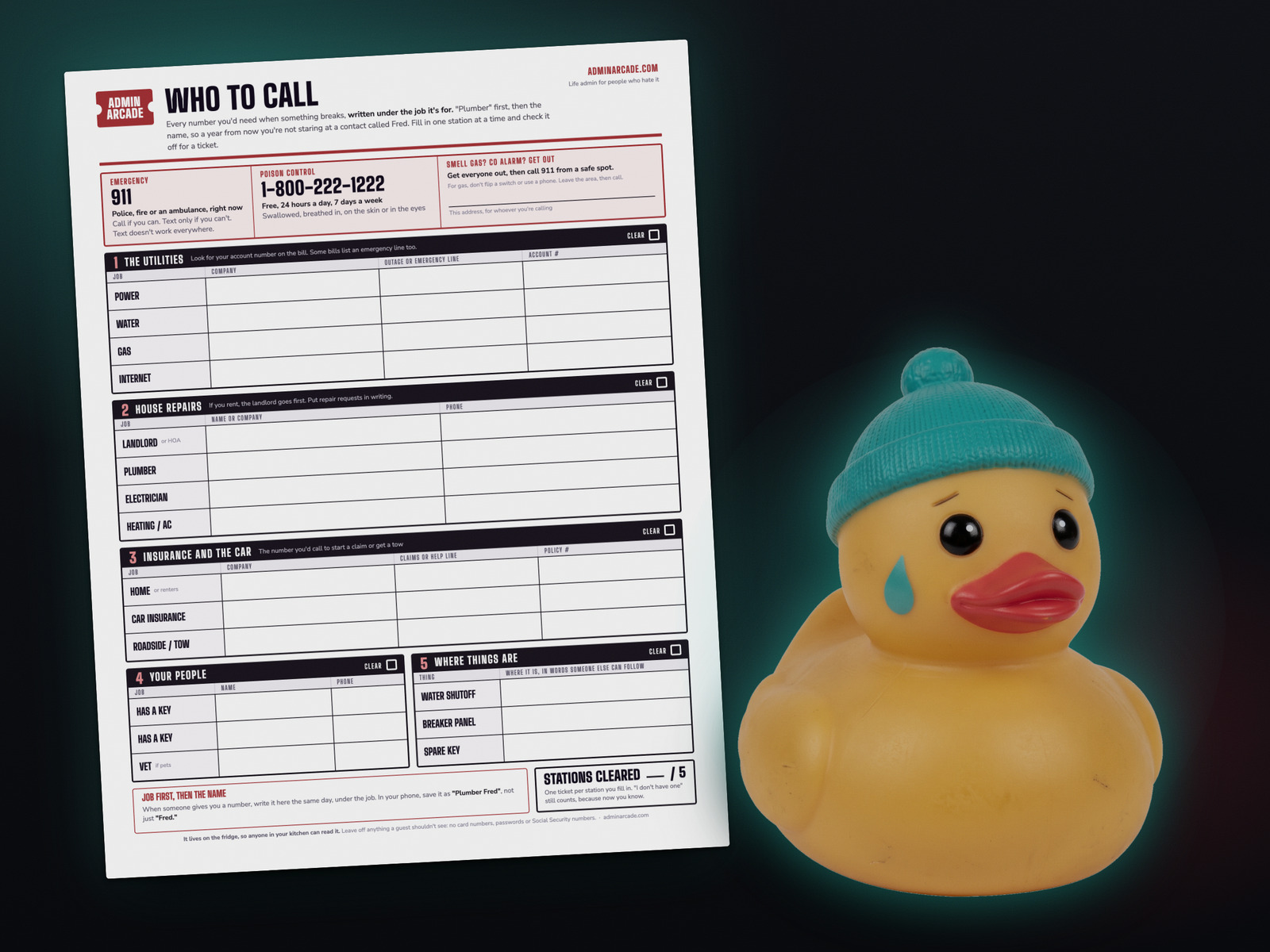
Knowing who to call when something breaks at home comes down to one page on the fridge with every number you’d need, each written under the job it’s for. Power, water, gas and internet outage lines with account numbers. The plumber, electrician and heating company. The insurance claims line, roadside help, the people with a key, and where the water shutoff is. Fill it in over five stations, so the number is there when it’s urgent.
My system is calling my dad
When something breaks at my house, I usually call my dad. He gives me a number.
Then I don’t write it down. When I do put a number in my phone, it’s not always saved with enough description. Say the plumber’s name is Fred. FRED a year from now isn’t going to scream PLUMBER to me.
What I want is the number sitting right there when it’s urgent, labeled with the job, so I’m not scrolling through contacts trying to remember who Fred is.
Ready.gov, FEMA’s preparedness site, puts it plainly: “Make sure you store important phone numbers somewhere besides just your cell phone.” A sheet on the fridge counts.
Five stations, one ticket each. Stop after any of them and you still have more written down than you did. The whole sheet fits inside an admin night.
The lines already printed at the top
Three boxes come filled in: 911, Poison Control, and what to do first if you smell gas or a CO alarm goes off.
- 911. 911.gov defines an emergency as “any situation that requires immediate assistance from the police, fire department or ambulance,” and says it’s “always best to call 911 if you can, and text if you can’t.” Texting doesn’t work everywhere, though. The FCC says “Text-to-911 is only currently available in certain locations.” If you’re not sure it counts, the National Emergency Number Association says “you should call 9-1-1.”
- Poison Control, 1-800-222-1222. HRSA, a federal health agency, says the Poison Help line gives “free and confidential help 24 hours a day, 7 days a week, 365 days a year.” HRSA’s FAQ says you can call with a question too, not only an emergency.
- Gas smell or a CO alarm: get out first. For gas, Con Edison says “Leave immediately and take others with you,” then call 911 or Con Edison once you’ve left the area. It also says don’t “flip a switch, ring a doorbell, or touch appliances or electronics, including your phone.” PSE&G in New Jersey says the same: call “Once you are at a safe distance.” For a carbon monoxide alarm, the Consumer Product Safety Commission says “Immediately move outside to fresh air. Call your emergency services, fire department, or 911.”
One thing I left off on purpose: shutting off the gas yourself. Ready.gov says to turn off the outside main valve “if you can.” SoCalGas says “DO NOT attempt to control the leak or repair a damaged pipe or meter.” With official sources pointing opposite ways, the sheet leaves it out.
Who to call when something breaks at home, by problem
Some of these have one answer. Some depend on who you ask, so I’m showing both.
| What happened | Who to call first, by source |
|---|---|
| You smell gas inside | Leave first, then call 911 or the gas company from a safe distance (Con Edison, PSE&G). |
| The CO alarm is going off | Outside first, then “emergency services, fire department, or 911.” Don’t go back in until responders say so (CPSC). |
| Someone swallowed or breathed in something | Poison Help, 1-800-222-1222, open 24 hours a day (HRSA). |
| A power line is down | It depends who you ask. The Electrical Safety Foundation International says report it to your utility, and call 911 if someone is touching it. FirstEnergy says call 911. Both say to assume it’s live. ESFI says the ground up to 35 feet away may be energized, and FirstEnergy says stay at least 30 feet away, or 100 feet from a transmission line. |
| Sewage is coming up a drain | It depends on the city. Seattle and Portland say a plumber first. New York City says 311. DC Water says its own emergency line. WSSC Water in Maryland gives its 24-hour emergency number and also recommends a registered plumber. |
| Something’s damaged and you have insurance | If you’re filing a claim, your insurer “right away,” with your policy number. The time you have to report “varies by state” (NAIC). |
Station 1: The utilities
Power, water, gas and internet. For each one: the company, the outage or emergency line, and the account number.
Look for the account number on your bill. Peoples Gas calls it “the number you will use when you contact Customer Service,” and PG&E’s bill guide says to “Have this 10-digit number ready to call us.” If you keep a printable bill calendar, you’ve already got the bills in one place.
An emergency line is sometimes on the bill and sometimes not. Peoples Gas prints its 24-hour emergency number on the back of its sample bill. The phone box on PG&E’s sample statement lists customer service numbers only, while its website header shows an outage number. Check the company’s site if the bill comes up empty.
Station 2: House repairs
I own my house, so mine is the plumber, the electrician and the heating and AC company. If you don’t have one yet, leave the line blank. The next time someone hands you a number, it goes here the same day. The heating and AC company is also the one you call on purpose rather than in a panic, and booking that in the fall is a row on the home maintenance schedule.
If you rent, the landlord or property manager goes on the first line. California’s attorney general says “Tenants should make repair requests and complaints about unsafe or unhealthy conditions in writing,” and to keep a copy. That’s California’s guidance, and your state’s rules may differ.
Station 3: Insurance and the car
Home or renters insurance, car insurance, and roadside help or a tow. Write the company, the claims or help line, and the policy number.
The policy number is on the sheet for a reason. The National Association of Insurance Commissioners says that if you decide to file a claim, “notify your insurance company right away” and to contact them “with your policy number, name, address, and phone number.” It also says “The amount of time you have to report your claim varies by state.”
Two more things from the NAIC worth knowing before you ever need them:
- Photos before cleanup. “Before removing any debris or belongings,” document the losses with photos or videos.
- Temporary repairs and receipts. Cover the hole or board the window. The NAIC says insurance “will typically reimburse the cost of these repairs as part of your claim if your insurance policy covers the loss.” Keep the receipts.
The roadside line lives here too, because a dead car on the side of the road is the same scramble. If you keep a car maintenance log, the insurance card and the roadside number are worth having with it.
Station 4: Your people
Two people who have a key, and the vet if you have pets. Name and phone for each.
The key people are the ones who can let a plumber in when you’re stuck at work. Write the job first here too: “Has a key: Linda next door” is findable, and “Linda” alone becomes another Fred.
Station 5: Where things are
The water shutoff, the breaker panel and the spare key. Write where each one is in words someone else can follow, because the person reading it might not be you.
Ready.gov says to “Find the shut-off valve for the main water line that enters your house and tag it for easy identification. Make sure everyone in your household knows where it is.” It also says this is “not the street valve in the cement box at the curb,” which “requires a special tool.”
WSSC Water in Maryland says a basement valve is “typically located near the front foundation wall,” and in a house on a slab, “near the water heater or under the kitchen sink, but anywhere is possible.” The same page says knowing how to turn off the main water “is as important as knowing how to find and reset an electric circuit-breaker,” so the breaker panel gets its own line too.
Fill in your sheet with Who to Call
Who to Call walks the same five stations. Type what you have, tap “I don’t have one” for what you don’t, and print the finished sheet. Anything you skip prints as a blank line, so you can write it in by hand later.
Nothing you type leaves your browser or gets saved, and there's no account, so print the sheet before you close the page.
The printable who-to-call sheet
One page, free, no email required. The three emergency boxes across the top, then the five stations with every line already labeled by the job: Power, Water, Gas, Internet, Landlord, Plumber, Electrician, Heating / AC, and the rest. There's a box to check off each station and a line for your address, for whoever you're calling.
It goes on the fridge, so anyone in your kitchen can read it. Leave off card numbers, passwords and Social Security numbers.
Two rules so the numbers stay findable
Job first, same day. When someone gives you a number, it goes on the sheet under the job before the day's over. In your phone, save it as "Plumber Fred," not just "Fred."
Keep a copy in two places. Ready.gov's free emergency plan template holds your family's contact information, and it says you can "store copies both digitally and on paper." Take a photo of the finished sheet so it's in your phone too, under a name you'll find.
Clear all five stations and you've earned five tickets and Drippy Dan, the prize on this one. Nothing expires and there's no streak to lose, so a sheet you start tonight and finish next month still pays the same five.

Not legal or insurance advice. Every safety instruction above is attributed by name from the agency, utility or organization that published it, and your local utility, insurer or state can differ. When in doubt in an emergency, call 911.
Frequently asked questions
What should be on a home emergency contact list?
911 and Poison Control at the top, then your power, water, gas and internet companies with their outage lines and account numbers. Add the plumber, electrician, heating and AC company, your insurance claims lines and policy numbers, roadside help, two people with a key, and where the water shutoff and breaker panel are.
Should I call 911 or the gas company if I smell gas?
Leave first, then call. Con Edison says to leave immediately and call 911 or Con Edison from a phone away from the area, and PSE&G says to call it or 911 once you're at a safe distance. Both say not to use a phone until you're out.
What is the number for Poison Control?
1-800-222-1222. HRSA says the Poison Help line gives free and confidential help 24 hours a day, 7 days a week, 365 days a year, and you can call with a question, not only an emergency.
Where is the main water shutoff valve?
It depends on the house. WSSC Water, a Maryland utility, says a basement valve is typically near the front foundation wall, and in a slab house near the water heater or under the kitchen sink, but anywhere is possible. Ready.gov says it's not the street valve in the box at the curb, and to tag yours once you find it.
Should I call 911 for a power outage?
Report an outage to your power company. FirstEnergy, for one, runs an outage reporting line and says to call 911 for an emergency such as a downed power line. Other sources differ on downed lines: the Electrical Safety Foundation International says report them to your utility, and call 911 if someone is touching one.
Is the who-to-call printable free?
Yes, and there's no email required to get it.
A tool I built
Emergency Fund Aquarium
Log what you save at your own bank and watch your tank fill with creatures. Your money never moves through the app.
Start your tank →I run an affiliate program on the tools I build. Approved affiliates earn 20% on what their referrals pay, for up to a year. US only for now. See the program →