Free Printable Home Maintenance Schedule + What’s Overdue
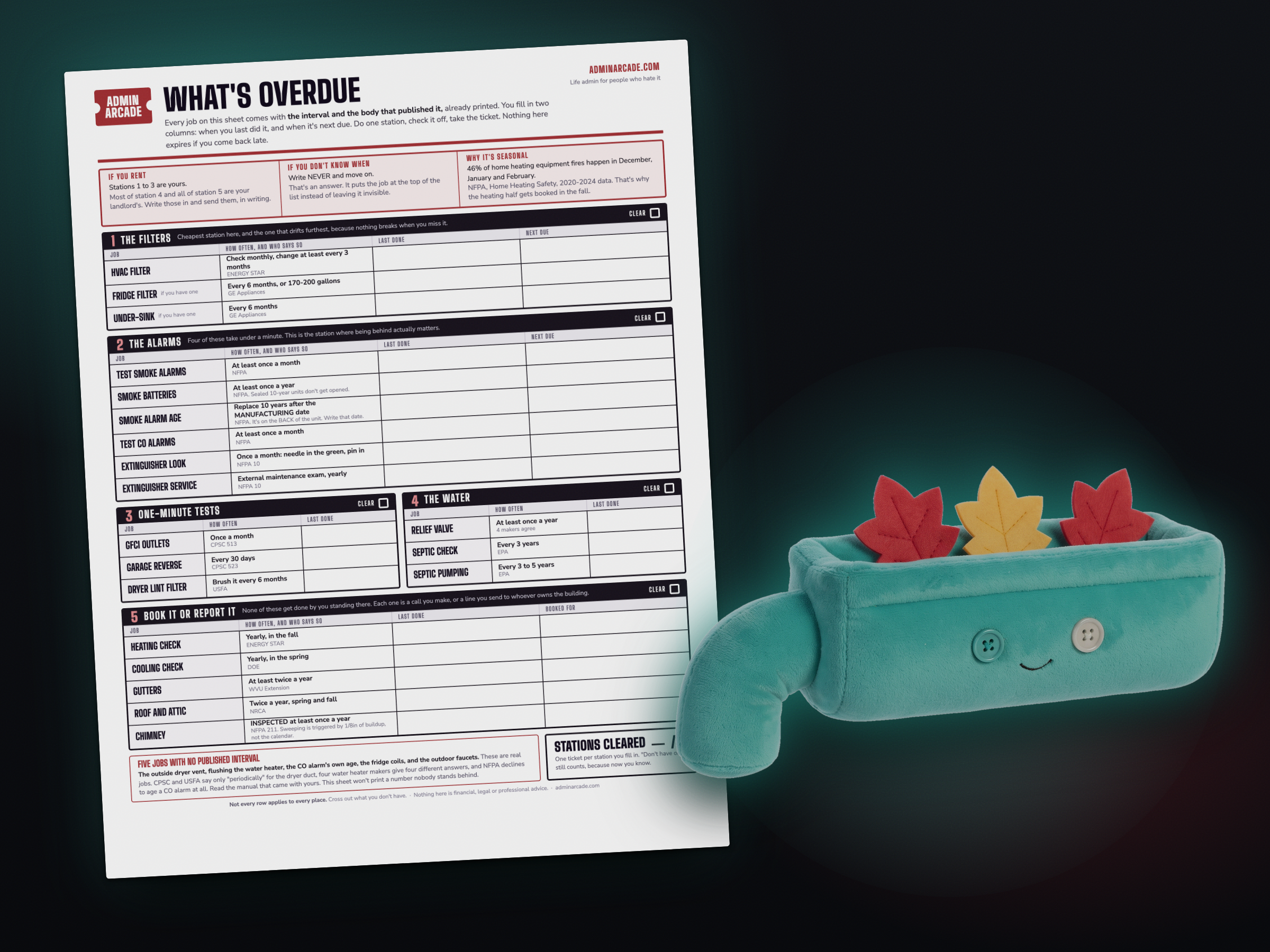
A printable home maintenance schedule lists each household job with how often it’s due and who published that interval, so you can see what’s overdue instead of guessing. This one covers five stations: the filters, the alarms, the one-minute tests, the water, and the jobs you book or report. Every interval on it comes from NFPA, CPSC, EPA, ENERGY STAR or the manufacturer. One page, free, no email.
Home maintenance intervals at a glance
| Job | How often | Source |
|---|---|---|
| HVAC filter | Check monthly, change at least every 3 months | ENERGY STAR |
| Refrigerator water filter | Every 6 months, or 170 to 200 gallons | GE Appliances |
| Smoke alarms, test | Monthly | NFPA |
| Smoke alarm batteries | At least once a year | NFPA |
| Smoke alarms, replace | 10 years after the manufacturing date | NFPA |
| CO alarms, test | Monthly | NFPA |
| GFCI outlets | Monthly | CPSC |
| Garage door and opener | Every 30 days | CPSC |
| Dryer lint screen | Before or after every load | CPSC |
| Dryer lint filter, deep clean | At least every 6 months | USFA |
| Water heater relief valve | At least once a year | Rheem, A.O. Smith, State, Bradford White |
| Septic system, inspect | At least every 3 years | EPA |
| Septic tank, pump | Typically every 3 to 5 years | EPA |
| Gutters | Twice a year | WVU Extension |
| Roof | Twice a year | National Roofing Contractors Association |
| Chimney, inspect | At least once a year | NFPA 211 |
| Heating system service | Booked in the fall | ENERGY STAR |
| Cooling system service | Booked in the spring | ENERGY STAR |
Five more jobs have no published interval at all. Those are listed further down, with what each source actually says.
Why I made a home maintenance schedule
Everything gets away from me if I don’t track it.
Even furnace filters, which is hilarious, because my family has an HVAC company. My filters are probably dirty AF right now.
My husband is good with a lot of things. We both still benefit from reminders and something to help keep it on a schedule.
Time flies by so quickly that all of a sudden a year has gone by and you haven’t looked at your outside dryer vent.
So the sheet holds the intervals and the tool does the subtraction. You put in when you last did something, it tells you how far past due you are.
One thing first. I went looking for the real number behind every job here, from the agency or the manufacturer. Twenty-six have one. Five don’t, and I left those blank instead of printing a number I could not trace to a source. The dryer vent is one of them.
Five stations, one ticket each. Stop after any of them and you know more about this place than you did an hour ago.
Station 1: The filters, and how often to change them
The cheapest station, and the one that drifts furthest, because nothing breaks right away when you miss it. The equipment just runs harder and dies sooner.
ENERGY STAR’s wording on the HVAC filter is “Check your filter every month, especially during heavy use months (winter and summer)… At a minimum, change the filter every 3 months.” Thickness changes it. Carrier puts a 1-inch fiberglass filter at 30 days and a 4-inch media filter at 6 to 12 months, so the number on your own filter beats the general one.
GE Appliances puts a refrigerator filter at “every six (6) months or usually after every 170-200 gallons.” The EPA publishes no interval for water filters at all and tells you to follow the maker’s instructions exactly.
Station 2: The alarms
Four of the six take under a minute, and this is where being behind actually costs something.
NFPA says to test all smoke alarms at least once a month, and that they need a new battery at least once a year. The third one catches people: “All smoke alarms must be replaced 10 years after its manufacturing date.” Not ten years after you put it up. Ten years after it was made, and the date is printed on the back. Take one down and look, because that’s a number you can’t guess at.
CO alarms get tested monthly too. How old is too old for one, NFPA won’t say, and CPSC gives no age either, so that row is in the blank list below.
Station 3: The one-minute tests
Three buttons and a lint screen. No ladder, no tools, no appointment, and all of it is yours whether you rent or own.
CPSC says to test every GFCI once a month, meaning the bathroom and kitchen outlets with the two little buttons. Press TEST, the power should cut, press RESET. CPSC also says to inspect the garage door and opener every 30 days.
The dryer is the one worth the minute. NFPA counted 13,820 home dryer fires a year, and failure to clean caused 32% of them and all seven of the civilian deaths. CPSC says to clear the lint screen before or after every load, and USFA adds a deeper one: clean the lint filter with a nylon brush at least every 6 months.
Station 4: The water heater and septic tank
Nothing in this station is dramatic until it is, and then it’s a floor.
The water heater’s temperature and pressure relief valve is the rare row where everyone agrees. Rheem, A.O. Smith, State and Bradford White all say at least once a year. Flushing the tank is the opposite, and it’s below.
If you’re on septic, the EPA says a system should be inspected at least every three years and is “typically pumped every three to five years.” They also price it: $250 to $500 every three to five years, against $5,000 to $15,000 to repair or replace a failed system. On city sewer, cross both rows off.
Station 5: Book it or report it
Nothing here gets done by you standing there. Each row is a call you make, or a line you send to whoever owns the building.
It’s also what makes the whole thing seasonal instead of random. NFPA: “Nearly half of the heating equipment fires (46%) occurred in the three-month period from December through February.” So the heating check gets booked in the fall, not in January when everyone else is calling. ENERGY STAR splits it the same way, cooling in the spring and heating in the fall.
Gutters go twice a year per WVU Extension, and the roof does too, per the National Roofing Contractors Association. The chimney row has a verb worth keeping straight: NFPA 211 says chimneys “shall be inspected at least once a year.” Inspected, not swept. Sweeping is triggered by an eighth of an inch of buildup, and the inspection is what finds it.
If you rent, this station is your report-it list, and the tool prints it that way. Getting it in writing is the job. When one of these turns into an emergency at 11pm, that’s the who-to-call fridge sheet instead.
The five jobs with no published schedule
Every seasonal checklist I looked at gives a confident number for these. I went to find where those numbers come from and they aren’t anywhere.
- The outside dryer vent. CPSC and USFA both say only “periodically.” No federal agency puts an interval on the duct. Whirlpool is the one maker with a number, every one to two years, and that’s Whirlpool’s, not a standard.
- Flushing the water heater. A.O. Smith’s site says once a year, its own manual says every six months, and Bradford White says drain off a gallon monthly. When a maker contradicts itself there’s no honest number to print.
- How old is too old for a CO alarm. NFPA declines. Kidde says seven to ten years for its own units, USFA’s checklist says under seven.
- Refrigerator condenser coils. Maytag says yearly, Whirlpool says a normal home doesn’t typically need it, and GE says models built after 2001 mostly never do.
- Outdoor faucets. Not one source names a month or a temperature. Portland Water Bureau says “before temperatures dip below freezing,” which is weather, not a calendar.
For all five, the answer is the manual that came with yours, which is one more argument for knowing how long to keep paperwork. The car has its own numbers and a separate log by mileage.
Check what’s overdue
Answer rent or own, then put in roughly when you last did each job. Month and year is enough. “Never” and “no idea” are answers too, and they send a job straight to the top of the list.
Nothing you type leaves your browser or gets saved, and there's no account, so print the list before you close the page.
The printable home maintenance schedule
One page, free, no email. The paper version of the same five stations, with the interval printed on every row:
- Every row carries its source in the row itself, so you're not taking my word for any of it.
- Two columns to fill in, when you last did it and when it's next due, plus a box for the five with no published interval so they're on the sheet without a fake date attached.
Print at 100% or "Actual size." Cross out anything you don't have. Not every place has a septic tank, a garage door or a chimney, and a row you cross out is still a row you decided about.
Two rules that keep it honest
"Never" goes on the sheet. The jobs that get away from you are the ones with no date attached, because a blank looks like nothing instead of looking overdue. Writing NEVER turns it into a line you can see.
Book the heating in the fall, not in the cold. December through February is when every HVAC company has a waiting list. Fall is the quiet time to get on the schedule.
Clear all five stations and you've earned five tickets and Gutter Gus, the prize on this one. Nothing expires and there's no streak to lose, so a sheet you start today and finish in three weeks pays the same five.

Not financial, legal or professional advice. Every recommendation above is attributed by name to the body that published it. Where they disagree, I said so instead of picking one.
Frequently asked questions
How often should you change a furnace filter?
ENERGY STAR says to check your filter every month and change it at least every 3 months. Thickness changes it: Carrier puts a 1-inch fiberglass filter at 30 days and a 4-inch media filter at 6 to 12 months. Follow the number on the filter you have.
How often should gutters be cleaned?
WVU Extension says rain gutters should be cleaned at least twice a year, and the City of Shaker Heights, Ohio says periodically, especially in the fall and spring. If you rent, this one is your landlord's.
When should you replace a smoke alarm?
NFPA says all smoke alarms must be replaced 10 years after the manufacturing date, which is printed on the back of the unit rather than the date you installed it. NFPA also says to test alarms monthly and change batteries at least once a year.
How often should a chimney be inspected?
NFPA 211 says chimneys, fireplaces and vents shall be inspected at least once a year. Inspected is not the same as swept. CSIA says sweeping is triggered by an eighth of an inch of buildup, and the yearly inspection is what finds it.
How often should you clean the dryer vent?
No agency or standards body publishes an interval. CPSC and USFA both say only to clean it periodically. Whirlpool is the one manufacturer with a figure, every one to two years, which is its own guidance and not a standard. NFPA counted 13,820 home dryer fires a year, with failure to clean causing 32%.
Is the printable home maintenance schedule free?
Yes, and there's no email required to get it.
A book I made
Sell It or Shed It
A declutter workbook for making money from what you don't use. One closet or drawer at a time: dump what's in it, mark each thing sell or shed, list five, and set a thirty-day check date.
Clear your first zone →I run an affiliate program on the tools I build. Approved affiliates earn 20% on what their referrals pay, for up to a year. US only for now. See the program →