Free Printable Car Accident Information Form
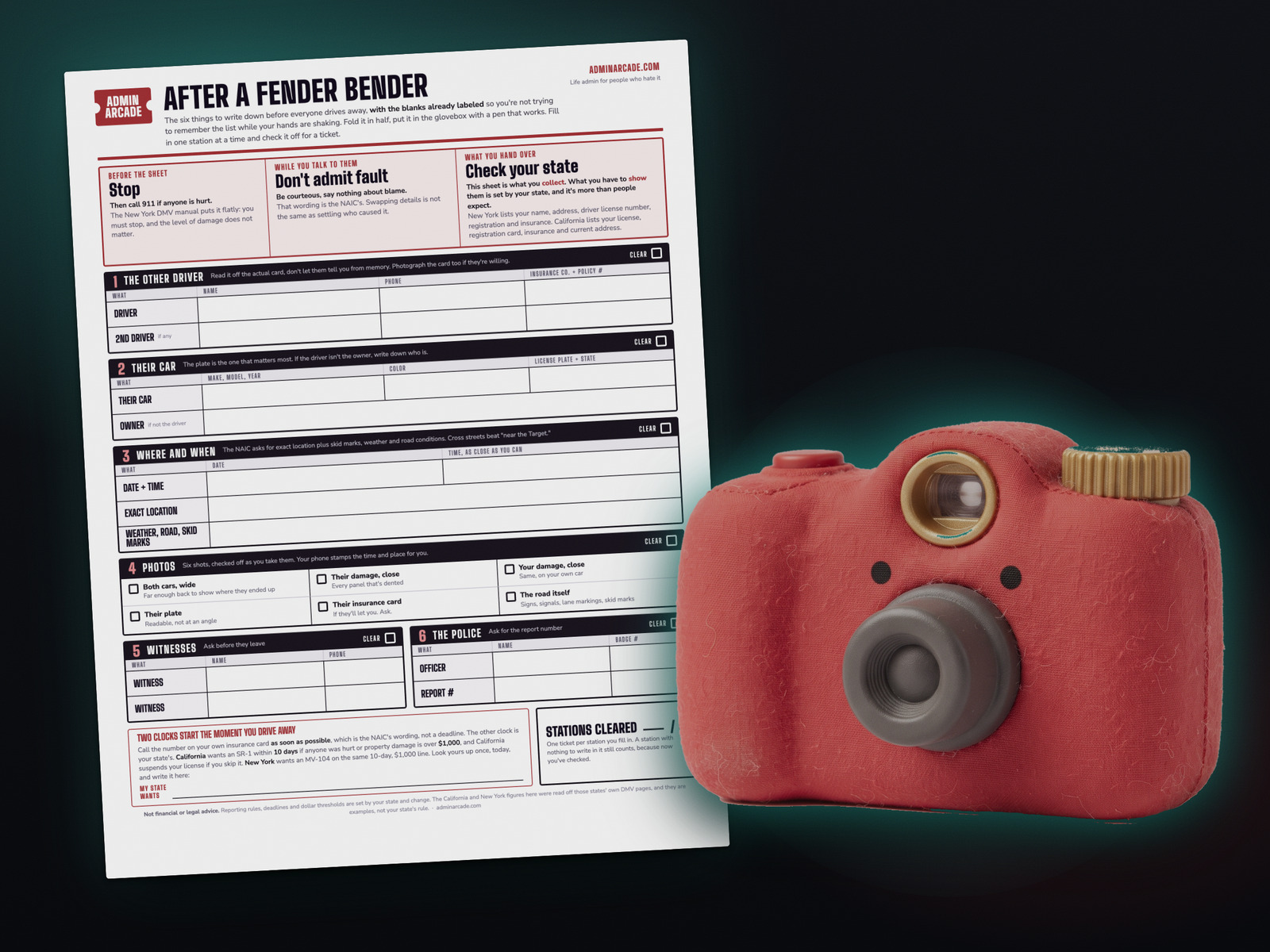
A printable car accident information form is the sheet you keep in your glovebox to write down what you need before everyone drives away: the other driver, their car, where and when it happened, your photos, the witnesses and the officer’s report number. Six stations, one page, free, no email. What you hand over to the other driver is a different list, and your own state sets that one.
Why the list is two lists
I’m not the car person in this house. Anything involving a vehicle zooms right past me unless it’s written down and in my face, which is the same reason the car maintenance log exists.
So I went looking for the actual list of what you’re supposed to write down, and found two of them.
The first is what you collect. The NAIC, which is the association the state insurance regulators run, publishes it: the other car’s make, model, year and plate number, the witnesses’ names and contact information, the name and badge number of the officer who comes, and “the time, date, and exact location of the accident, with notes of skid marks, weather, and road conditions.” That list is the sheet.
The second is what you hand over, and it’s bigger than most of the advice makes it sound.
What you have to show the other driver
New York’s driver’s manual says you must provide “your name, address, driver license number, vehicle registration, and insurance information. This includes the insurance policy number and effective date.” California’s handbook says to show “your driver’s license, vehicle registration card, insurance information, and current address.”
The NAIC’s own consumer article points the other way. It says to give the other driver only your name and insurance information, because handing over your address or driver’s license number can expose you to identity theft.
Both things are true at once. The identity theft risk is real, and so is your state’s law, and the law is the one with a penalty attached. So this post isn’t going to tell you what to withhold. Look up your own state’s rule on your own DMV’s site once, while nothing is happening, and write it on the sheet. There’s a line for it.
One thing both New York and the NAIC agree on. New York’s manual: “If you are in a crash, you must stop. The level of damage does not matter.” And the NAIC’s wording for the part right after: “Be courteous, but do not admit fault.”
Six stations below, one ticket each. Stop after any of them and you’ve still got more written down than you did.
What each source says you hand over
Same question, three answers. The two states are telling you what the law requires. The NAIC is giving consumer advice about identity theft, and it has no power to excuse you from either state’s rule.
| What they ask for | New York DMV | California DMV | NAIC advice |
|---|---|---|---|
| Your name | Required | Required | Give it |
| Your address | Required | Required, current address | Hold back, identity theft risk |
| Driver license number | Required | Required, show the license | Hold back, identity theft risk |
| Vehicle registration | Required | Required, the registration card | Not mentioned |
| Insurance information | Required, with policy number and effective date | Required | Give it |
Station 1: The other driver
Name, phone, insurance company, policy number. Four boxes.
Read the insurance details off the actual card rather than letting someone recite them. A policy number recited from memory and written down wrong is worse than a blank, because a blank tells you to go find it and a wrong one doesn’t.
Station 2: Their car
Make, model, year, color, plate number and the state on the plate.
The plate is the one to get first. Everything else about a car can be described badly and still be findable from the plate, and “silver-ish sedan” is a fine answer for the rest if it’s all you’ve got.
There’s one more box here: the owner, if the person driving isn’t the one who owns it. That’s a normal situation and it changes whose insurance is involved.
Station 3: Where and when
Date, time, exact location, and then weather, road and skid marks in one box.
Exact is the word doing the work. Cross streets, a mile marker, or which entrance of the lot. “Near the Target” describes about nine places in my town.
Weather and road conditions feel like padding until you notice the NAIC asks for them by name, alongside skid marks. Wet, dark, no streetlight is three words and it’s the kind of detail nobody reconstructs a month later.
Station 4: The six photos
This is the station to do first and fill in second. The NAIC’s instruction is to “take a photo or sketch a diagram of the accident scene,” and a phone stamps the time and place onto every shot without being asked.
- Both cars, wide. Far enough back to show where they ended up.
- Their damage, close. Every panel with a dent in it.
- Your damage, close. Same again, on your own car.
- Their plate. Readable, straight on, not at an angle.
- Their insurance card, if they’ll let you. Ask.
- The road itself. Signs, signals, lane markings, skid marks.
Six checkboxes on the sheet, so the ones you missed are visible while you’re still standing there and can go back for them.
Station 5: Witnesses
Name and phone, twice. The NAIC lists witnesses’ names and contact information in the same breath as the other driver’s details.
Witnesses leave. They stop, they check nobody is hurt, and once it’s clear everyone is fine they get back in their car, because they have somewhere to be. If somebody stayed, ask before that happens. If nobody stayed, the station is blank and it still counts, because now you know there weren’t any.
Station 6: The police
Officer name, badge number, report number, and which department.
The NAIC says to get the officer’s name, badge number and contact information, and to ask when and where to get the accident report and its number. The report number is the piece you’ll be asked for later, and it’s the easiest one to drive away without.
If no officer came, the NAIC’s line is to file an incident report anyway. Then this station stays blank.
Fill it in on your phone
Glovebox is the same six stations as a form. Fill them in and it hands back one plain summary you can screenshot or copy straight into the message to your insurer, with the blank fields left out instead of printed as empty labels.
It’s for after, not during. If you’re standing at the scene, take the photos and get the card. This is for once you’re parked somewhere safe and turning a pile of photos and scribbles into something you can send.
Nothing you type leaves your browser. There’s no account, no server and nothing saved, which is also why it tells you to copy the summary before you close the page.
The printable car accident information form
One page, free, no email. The paper version of the same six stations, with every blank labeled on the sheet itself:
- The six photos are checkboxes, not a paragraph you have to read while your hands are shaking.
- A line for your own state's reporting rule, so you look it up once today instead of at the worst possible moment.
Print at 100% or "Actual size," fold it in half, and put it in the glovebox with a pen that works. I'm serious about the pen.
Two rules that make it stick
The sheet goes in the car, not in a folder. A glovebox sheet in a filing cabinet is a piece of paper about a car accident. In the glovebox it's the thing you reach for. That's the same reason a safety hammer belongs in the car instead of a drawer at home. The same goes for the registration card, which is one of the dates on the things that expire list.
Two clocks start when you drive away. The first is your insurer's, and the NAIC's wording for it is to call the number on your proof-of-insurance card "as soon as possible," which is guidance rather than a deadline. That number belongs on your who to call sheet too. The second clock is your state's, and it's a real deadline.
California wants an SR-1 filed with the DMV within 10 days if anyone was hurt or killed, or property damage is over $1,000, and California suspends your driving privilege if you don't file it. New York wants an MV-104 on the same 10-day, $1,000 line. Those are two states out of fifty, so treat them as examples of the shape and go find yours.
Clear all six stations and you've earned six tickets and Flash Frank, the prize on this one. Nothing expires and there's no streak to lose.

Not financial or legal advice. Reporting rules, deadlines and dollar thresholds are set by your state and they change. Every figure above is attributed by name to the body that published it, and where the sources disagree I said so instead of picking one.
Frequently asked questions
What information should you exchange after a car accident?
The NAIC's collect list is the other car's make, model, year and license plate number, the witnesses' names and contact information, the responding officer's name and badge number, and the time, date and exact location with notes of skid marks, weather and road conditions. What you have to hand over is separate and your state sets it.
Do you have to report a car accident to the DMV?
It depends on your state. California requires an SR-1 within 10 days if anyone is injured or killed or property damage is over $1,000, and says your driving privilege will be suspended if you fail to file. New York requires an MV-104 within 10 days on the same $1,000 line. Check your own state's DMV rather than assuming those numbers apply.
Should you call the police for a minor fender bender?
The NAIC says to call the police and tell them about any injuries, and that if the police are not dispatched you should file an incident report. New York's driver's manual adds that you must stop no matter how small the damage is.
What photos should you take after a car accident?
Six cover it: both cars wide enough to show where they ended up, their damage close, your damage close, their plate straight on, their insurance card if they agree, and the road itself with its signs, signals and skid marks. The NAIC's instruction is to take a photo or sketch a diagram of the scene.
Do you have to give the other driver your driver's license number?
That one is set by your state. New York's driver's manual lists your name, address, driver license number, vehicle registration and insurance information. California's handbook lists your license, registration card, insurance information and current address. The NAIC separately warns that giving out your address or license number can expose you to identity theft, so look up your own state's requirement before you need it.
Is the printable car accident information form free?
Yes, and there's no email required to get it.
A tool I built
Emergency Fund Aquarium
Log what you save at your own bank and watch your tank fill with creatures. Your money never moves through the app.
Start your tank →I run an affiliate program on the tools I build. Approved affiliates earn 20% on what their referrals pay, for up to a year. US only for now. See the program →