Free Printable Bill Calendar + The Week Money Gets Tight
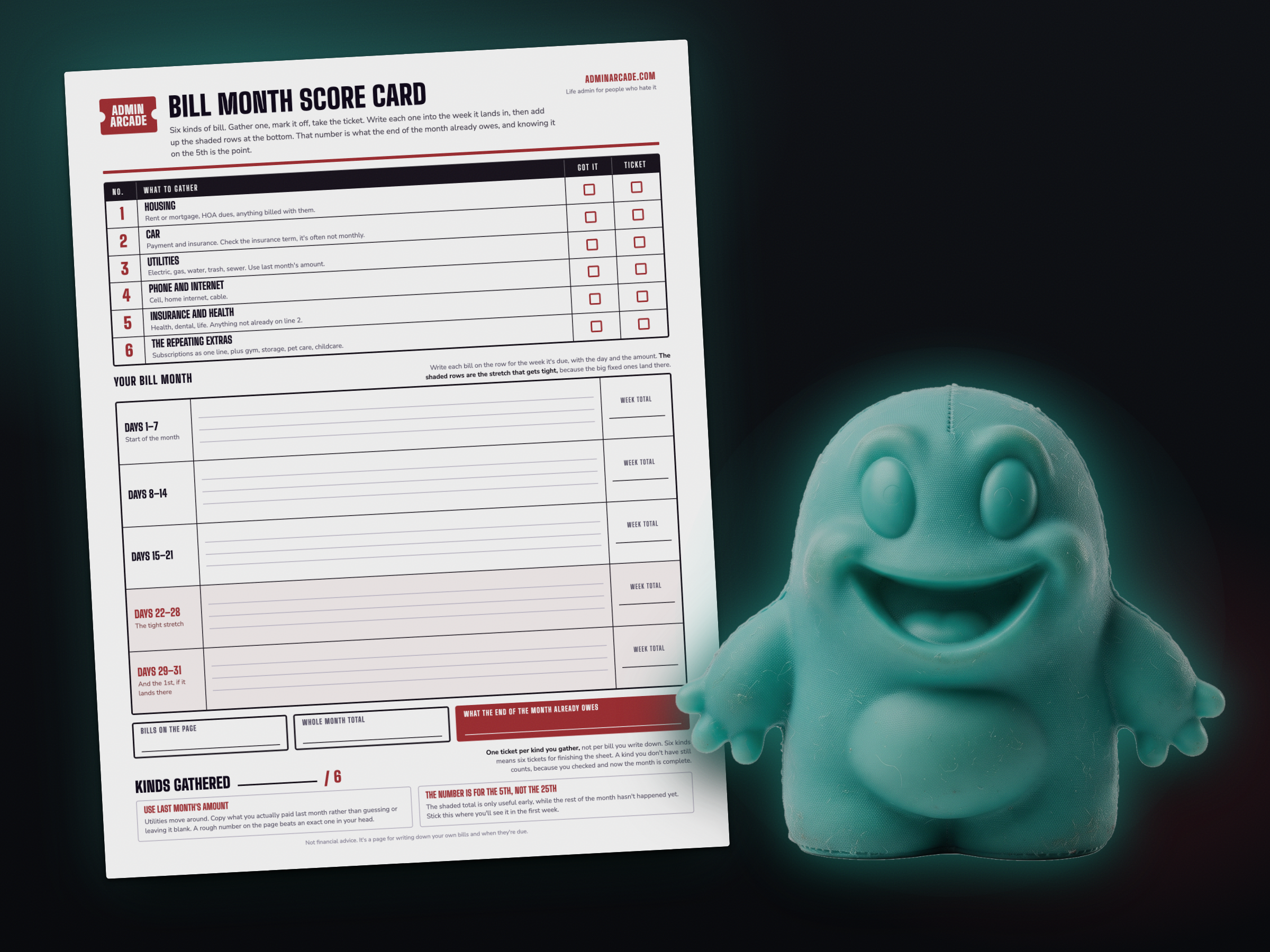
A printable bill calendar puts every bill on the week it’s due, so you can see which stretch of the month is heaviest before you get there. Gather six kinds of bill, write each one into its week, then add up the last two rows. That number is what the end of the month already owes, and it’s worth knowing on the 5th instead of the 25th.
The last week of the month is when I find out
The big ones land at the end. Mortgage, car payment, the things that don’t move. And that last stretch is where I find out whether I went too crazy with grocery shopping during the month, or with other purchases that felt fine at the time.
Nothing goes wrong on the 12th. The 12th feels fine. It’s the 26th that tells me what the 12th actually cost, and by then there’s nothing to do about it except watch.
That’s the part a bill calendar fixes. I know when my mortgage is due, so the due date was never the thing I needed written down anywhere. What I don’t carry around in my head is how much of the month is already promised to it before the first week is over, and that’s the number that would change what I do with the rest of it.
What goes on a bill calendar?
Housing, car, utilities, phone and internet, insurance and health, and the repeating extras. Do them in that order, because the first two are most of the money and the rest go quickly once you’re sitting there.
- Housing. Rent or mortgage, HOA dues, anything billed alongside them. Usually the biggest single line on the page, and usually near the start or the end of the month.
- Car. Payment and insurance. Check the insurance term while you’re in there, because car insurance is often billed every six months rather than monthly, and a six-month bill landing in a heavy week is the kind of thing that turns a tight stretch into a bad one.
- Utilities. Electric, gas, water, trash, sewer. These move around, so use what you actually paid last month rather than guessing.
- Phone and internet. Cell, home internet, cable. Usually the same every month, which makes them the fast ones.
- Insurance and health. Health, dental, life, and anything not already sitting on the car line.
- The repeating extras. Gym, storage, pet care, childcare, and subscriptions as one rolled-up line. If you don’t know what that line adds up to, that’s its own job, and I’ve written the subscription sweep and the seven places subscriptions hide for exactly that.
A kind you don’t have still counts. If you don’t have a car, check it off and move on, because the total only means something once every kind is accounted for.
Why is the end of the month the tight part?
It’s structural, and it has nothing to do with how careful you were.
Your fixed bills are clustered. Housing and a car payment sit on fixed dates, and those dates land at the start or the end of the month. They’re also the two biggest lines on the page. Your variable spending isn’t clustered at all. Groceries, gas, the Target run, the thing you had to replace the week it broke, all of that spreads evenly across all four weeks.
So the spending happens early and the big bills arrive late. That’s the whole mechanism. The last stretch ends up holding the fixed costs after the earlier weeks have already spent the flexible part, which is how it gets tight in a month where you were being careful the whole time.
Which is why the number is only useful early. Working it out on the 26th tells you what already happened, and there’s nothing left to do with it. Working it out on the 5th leaves you three weeks of month to know it in.
Build your bill month with the tool
It walks you through the six kinds one at a time, because opening every account at once is how this gets abandoned. Put in each bill with the day it’s due and the amount. At the end you get your month laid out by week, with the last stretch marked and its total worked out, plus what share of the whole month is sitting in it.
Nothing you type leaves your browser. There’s no account, no login, and no server behind it to send anything to. It saves on your own device so you can stop halfway and come back.
Six kinds gathered is six tickets, whether or not you had all six. A kind you don't have still counts, because you checked and now the month is complete.
Get the printable bill calendar
One page. The six kinds run across the top as a checklist, the month sits underneath as five week rows with room to write, and the last two rows are shaded because those are the ones that get tight. The box at the bottom right is where the shaded rows get added up, and that's the number the whole sheet exists for.
No email, no signup. It's a PDF.
How do you make a bill calendar stick?
Use last month's actual amount, not a guess. Utilities move, and the temptation is to leave them blank until you know. Blank lines are how the sheet ends up half-finished in a drawer. Copy what you really paid last month and correct it next time.
Put it somewhere you'll see it in the first week. This is the one I get wrong. A number that lives in a folder is a number you look up after you needed it. The fridge, the inside of a cabinet door, a photo on your phone, anywhere you'll pass it early in the month while the month can still go differently.
If some of what you found turns out to renew once a year rather than monthly, that belongs on a different page, and I've written that one too: things that expire and the yearly renewals list.

Month Muncher has a paper version. The Prize Counter is a blank sheet of twelve circles you print once and keep, and the prize stickers are the ones you cut out and stick on it. Both are free on one page, and that page always has the newest prizes.
Gathered the six kinds on paper instead of in the tool? That still counts. Nothing on this site is locked behind a sticker, and the tally only ever goes up.
Questions people ask
What should go on a bill calendar?
Six kinds cover a normal household: housing, car, utilities, phone and internet, insurance and health, and the repeating extras like gym, storage, pet care and subscriptions. Put each one on the day of the month it's due with the amount. A kind you don't have still gets checked off, because the total only means something once every kind is accounted for.
What's the difference between a bill calendar and a budget?
A bill calendar only records what you already owe and when it lands. It doesn't tell you what to spend, what to cut, or what to save. All it holds is dates and amounts you're already committed to, which is why it works even if you've never kept a budget in your life and don't intend to start.
What do I write for utilities when the amount changes every month?
Use what you actually paid last month. It'll be wrong by a bit and that's fine. The whole page is a rough shape of the month, and a number that's off by twenty dollars still tells you far more than a blank line you meant to come back to.
Why does the end of the month always feel tighter?
Because your fixed bills are clustered and your flexible spending isn't. Housing and a car payment sit on fixed dates at the start or the end of the month, and they're the two biggest lines on the page. Groceries and everything else spread evenly across all four weeks. So the flexible money goes early and the big fixed bills arrive late.
Is it safe to type my bills into the tool?
Nothing you type leaves your browser. There's no account, no login, and no server behind the tool to send anything to. It saves on your own device so you can come back to a half-finished month, and there's a button that wipes it. Don't type account numbers into it, or into anything else. It only needs the name, the day and the amount.
What if my paycheck doesn't line up with the calendar month?
The page still works, because the bills land when they land no matter when you're paid. If you're paid every two weeks, the useful move is to mark your pay dates on the same sheet so you can see which stretch of bills sits between two checks. That's a small addition to a page you've already filled in.
Not financial advice. It's a page for writing down your own bills and when they're due.
A tool I built
Side Hustle Garden
Log every side hustle payment and watch it knock out your monthly bills, smallest first.
Plant your first dollar →I run an affiliate program on the tools I build. Approved affiliates earn 20% on what their referrals pay, for up to a year. US only for now. See the program →