Free Printable Before-You-Leave List: Refills, Bills, Mail
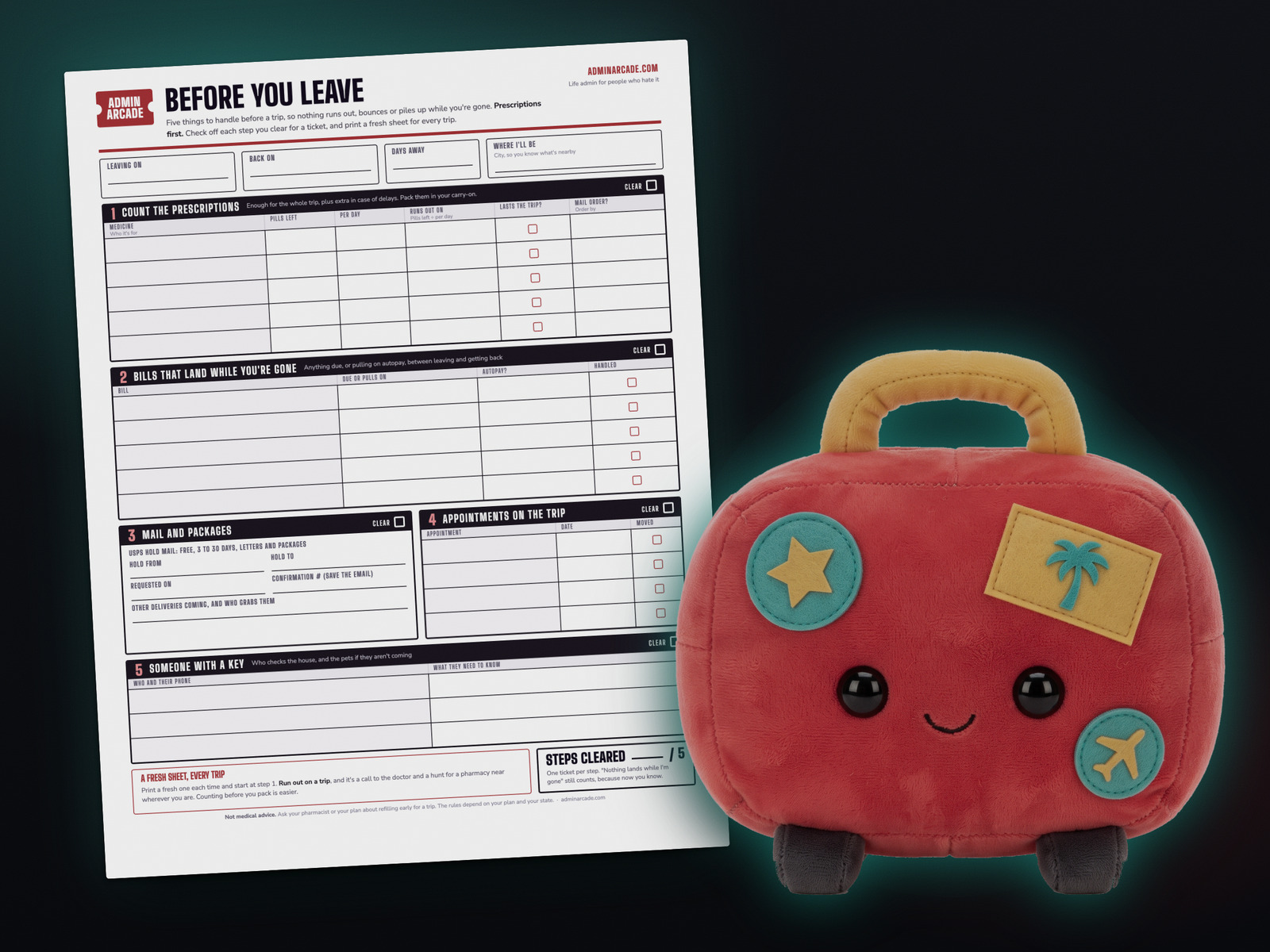
A before-you-leave list covers the five things that lapse while you’re away: prescriptions that run out mid-trip, bills due or pulling on autopay between your travel dates, mail and packages piling up, appointments that land on the trip, and someone with a key to the house. Count the pills first. USPS Hold Mail is free and holds your mail for 3 to 30 days. Clear all five before you go.
The blood pressure pills that ran out on a work trip
My husband had to go work out of town and ran out of his blood pressure pills.
We had to call the doctor, get them to call in a prescription at CVS instead of our normal mail order, and find the CVS by him. All doable, but what a pain.
We take inventory of all the essential prescriptions before trips now. The rest of this list is the same idea: handle it before you leave, so you can fully relax once you’re there.
Five steps, one ticket each. Stop after any of them and you’ve still covered more than you had.
Step 1: Count the prescriptions before you pack
For each prescription, write down the pills left and how many you take a day. Pills left divided by pills a day is how many days you have. Count that many days forward from today, and if that date lands before you’re back, it goes to the top of the list.
The CDC’s advice for traveling abroad says to “take enough to last your entire trip, plus extra in case of travel delays” and to “Pack medications in a carry on in case your luggage is lost or delayed.” It also says that for a trip longer than 30 days, “Some insurance companies will only pay for a 30-day supply at a time,” so talk to your health care provider about how to get enough medicine for the trip.
Mail order needs a head start. Optum Home Delivery’s 2022 welcome sheet recommends “refilling your medications at least 7-10 days before running out,” and Express Scripts says refills “usually arrive 5 to 8 days after we receive your order.” If you already keep the appointment and refill tracker, your run-out dates are already on it.
If the count comes up short and the refill isn’t due yet, call the pharmacy or the number on your plan card before you go. Express Scripts says “early refills of medication are usually not allowed,” and if you have Medicare drug coverage, Medicare.gov says you can contact your plan “to see if you can get a 2- or 3-month supply for drugs you take regularly.” Each plan has its own rules, so ask yours.
If you run out of medication while traveling
What we did turns out to be the first option Express Scripts lists. Its pharmacy blog calls getting a new prescription “An efficient way to get your medication,” and says to “contact your doctor’s office and request they send a new prescription to the pharmacy you want to use.”
If the pharmacist can’t reach your doctor, some states let the pharmacist give a short emergency refill. Texas and Florida generally allow 72 hours, and the rules differ by state and by drug, so ask the pharmacist what your state allows.
Step 2: Find the bills that land while you’re gone
Write down anything due, or pulling on autopay, between the day you leave and the day you’re back. A printable bill calendar already has the days, and the autopay list has everything that pulls on its own.
Autopay from a bank account still needs money in it. The Consumer Financial Protection Bureau says “Both the bank and the company might charge you a fee if there is not enough in your account.” Pay the manual ones early, and check that the account covers the automatic ones.
Three card issuers say you don’t need to tell them before a trip. Chase says it “no longer accepts travel notices,” Capital One says “travel notifications are not needed,” and American Express says “you don’t need to notify us before you travel.” Discover’s site still lists a travel notification in its app. American Express recommends keeping your contact information updated in case it needs to reach you, and Chase says up-to-date contact information can help your issuer reach you.
Step 3: Hold the mail and plan for packages
USPS Hold Mail is “a free service that pauses ALL mail delivery (letters and packages)” for “a minimum of 3 days and a maximum of 30 days.”
- When to ask: “up to 30 days in advance of the start date or as early as the next scheduled delivery day.”
- How: online with a USPS.com account, which asks you to verify your identity, by calling 1-800-ASK-USPS (1-800-275-8777), or in person at your Post Office with PS Form 8076. USPS says online requests aren’t available at every address.
- Longer than 30 days: USPS says to sign up for Forward Mail instead.
- Plans change: save the confirmation email. USPS says that with a confirmation number, you can edit or cancel the hold “By following the link provided in your confirmation email” or by calling.
- When you’re back: when you request the hold, you choose whether the carrier delivers it on the last day or you pick it up at the Post Office. Mail you pick up “must be picked up within 10 days or it will be returned to the senders.”
The Postal Inspection Service puts the reason plainly: “a visible pile of delivered mail and packages is a signal to thieves that you are not home.”
For packages coming from other shippers, the Federal Trade Commission says “Many shippers will let you specify where to leave packages,” including “redirecting them to a trusted neighbor’s address, if you won’t be home.” Write down what’s coming and who’s picking it up.
Step 4: Move the appointments that land on the trip
Look at your calendar for the trip dates and write down anything booked: the dentist, a car service, a delivery window. Move it or cancel it before you go, and check it off.
Checking and finding nothing still clears the step, because now you know.
Step 5: Leave a key with someone
Write down who has a key, their phone number, and what they need to know. Where the water shutoff is. That a package is coming Thursday. Which plant is the one that dies if you look at it wrong.
If you have pets and they aren’t coming, their care goes here too. We usually bring the pets, or I don’t go. I kind of refuse to leave my pets.
The person with the key can also pick up your held mail. USPS says you can authorize someone by giving the Post Office written permission, and that person has to show ID.
If the person checking on the house needs more than a key, hand them your who-to-call sheet so they know who to call when something breaks.
Check your dates with Before You Leave
Before You Leave walks the same five steps. Enter the day you leave and the day you’re back, and it tells you which prescriptions run out before you’re home, which bills land on the trip, and the first day you can request Hold Mail. Then print the finished list.
Nothing you type leaves your browser or gets saved, and there's no account, so print the list before you close the page.
The printable before-you-leave list
One page, free, no email required. Your trip dates across the top, then the five steps: a prescription count with a "runs out on" column, five rows for bills, the Hold Mail dates and confirmation number, appointments to move, and the people with a key.
Two rules so nothing lapses
Count the prescriptions the day the trip is booked. Mail order needs days to arrive, so the earlier the count, the more options you have.
A fresh sheet every trip. Start at step 1 each time, even for a weekend.
Clear all five steps and you've earned five tickets and Carry-On Carl, the prize on this one. Nothing expires and there's no streak to lose, so a list you start for this trip and finish for the next one still pays the same five.
Not medical, legal or financial advice. Every outside rule above is attributed by name to the agency, state law, pharmacy company or card issuer that published it, and your plan, pharmacy and state can differ. Ask your pharmacist or plan about refills before a trip.
Frequently asked questions
How long can USPS hold my mail?
USPS Hold Mail lasts a minimum of 3 days and a maximum of 30 days, and it's free. It holds letters and packages, and you can request it up to 30 days before the start date. For longer than 30 days, USPS says to use Forward Mail.
Can I get my prescription refilled early for a trip?
It depends on your plan, so call before you go. Express Scripts says early refills are usually not allowed, and Medicare.gov says people with Medicare drug coverage can contact their plan to see if they can get a 2- or 3-month supply of drugs they take regularly.
What do I do if I run out of medication while traveling?
Call your doctor and ask them to send a new prescription to a pharmacy near you. Express Scripts calls that an efficient way to get your medication. If the pharmacist can't reach your doctor, some states let the pharmacist give a short emergency refill. Texas and Florida generally allow 72 hours, and the rules differ by state and drug, so ask the pharmacist.
Do I need to tell my credit card company I'm traveling?
Chase, Capital One and American Express each say travel notices aren't needed, and Discover's site still lists a travel notification in its app. Keep your contact information current so the issuer can reach you.
Can I bring my pills on a plane?
Yes. TSA says medication in pill or solid form is allowed "in unlimited amounts if it is screened," and it strongly recommends your carry-on. TSA doesn't require prescription bottles, but some state labeling laws still apply.
Is the before-you-leave printable free?
Yes, and there's no email required to get it.
A book I made
The Lightest One
An undated ADHD daily book that never asks you to prioritize. Dump everything in your head, mark each thing light, medium or heavy, and do the lightest one.
Get the paperback →I run an affiliate program on the tools I build. Approved affiliates earn 20% on what their referrals pay, for up to a year. US only for now. See the program →