Free Printable Side Hustle Income Log + Who Sends You a 1099
A side hustle income log is one page listing every place that pays you, what each one paid, and whether it sends you a form in January. Most of them won’t. A payment app only files a 1099-K above $20,000 and 200 transactions, and a company only files a 1099-NEC at $2,000 for 2026. Under those, nothing arrives, and your own log is the only record.
I couldn’t tell you who pays me without going to look
Ask me right now to name every place my money comes in from and I’d have to go look. I know roughly. I couldn’t list them, and I’ve been doing this for years.
The companies that pay me through PayPal don’t send me anything, because PayPal handles that side of it. PayPal does send me a 1099-K, and I’m usually over their threshold. But it’s one lump number for the year. It doesn’t break out which company paid me or how much each sent, and the breakdown is the part I need. So I keep my own books to know my totals.
Then there’s the other half of it. Things showed up after I’d already done my taxes. Not one thing, several things. Which is why you can’t wait on the forms and treat what arrived as the full picture.
I had QuickBooks back then and I don’t now. I keep the books myself in a base I built, and the software was never the part doing the work. And every year our accountant asks the same few questions about my husband’s job, and every year we’ve forgotten to have the answers ready. We know they’re coming.
Start with a roll call of everyone who pays you
Before any numbers, just names. Every place money has landed this year, including the one that paid you twelve dollars in March and never again.
It’s the step that gets skipped for feeling too basic, and the one that eats an afternoon in January when it hasn’t been done. Reconstructing a payer list out of a year of email is miserable. Writing a name down the day someone pays you takes four seconds.
If you’re stuck: bank deposits, PayPal or Stripe history, your email for the word “payout”, and any marketplace you’ve sold through.
Which payers actually send you a 1099?
This is the part worth knowing before January, because the answer for a small side hustle is usually “hardly any of them.” Here’s what the IRS actually requires a payer to file for tax year 2026.
| What you got paid for | The form | When they have to file it |
|---|---|---|
| Sales through a payment app or marketplace | 1099-K | Over $20,000 and more than 200 transactions. Both, not either one. |
| Work you did for a company, not as an employee | 1099-NEC | $2,000 for 2026. It was $600 before 2026. |
| Royalties, so books, print on demand, music | 1099-MISC | $10 or more, which the 2026 change didn’t touch. |
| Rent, or income that fits nowhere else | 1099-MISC | $2,000 or more. |
Read those two middle rows next to each other. Twelve dollars of book royalties generates a form. Nineteen hundred dollars of freelance work doesn’t. The paperwork you get has almost nothing to do with how much you earned.
Who files when a client pays you through PayPal?
The payment app does, and the client doesn’t. The IRS instructions are explicit: “Payments made with a credit card or payment card and certain other types of payments, including third-party network transactions, must be reported on Form 1099-K by the payment settlement entity under section 6050W and are not subject to reporting on Form 1099-MISC or Form 1099-NEC.”
So a client who sends you $4,000 through PayPal files nothing, even though that’s well over the 1099-NEC threshold. PayPal picks it up instead, and only if your whole account clears $20,000 and 200 transactions.
And if you do clear it, the 1099-K is one figure covering every client who paid you that way. It doesn’t say who they were or what each of them sent, so it can’t give you the per-client numbers you need.
The 1099-NEC line is the one that moved this year. At $2,000, a client who sends you $1,500 directly files nothing, where the same work would have generated a form a year ago. More money arrives with no paperwork behind it than it used to.
None of which changes what you report. The IRS says it in one sentence: “Whether or not you receive a Form 1099-K, you must still report any income on your tax return.” A form is paperwork about you, and it was never the record.
Which of your payers send you nothing?
Payout Roll Call walks you through it in five steps. Name your payers, say what kind each one is, band the size, note where you’d go to get its total, and pick one folder. It splits your list in two, and the number at the top is how many send you no paperwork at all.
Not sure is an answer at every step. You don’t need any accounts open to run it.
Nothing you type into it leaves your browser. There's no account and no server behind it.
Get each payer's own total, not your memory of it
Every payer holds a number for you somewhere. A reports tab, a payouts page, a statement email, or your own deposits added up. The job is finding that page once and writing down where it was.
Doing it once turns next January into opening five pages you already have links to. The payers with a dash in the form column are the ones to do first, because nothing is coming to remind you those totals exist. Once you have the totals, the next question is whether the whole thing is actually making money, and I wrote that one up separately: is my side hustle profitable.
Build the 1099 folder before you need it
One folder per tax year, one file per payer inside it. Anything about money goes in the day it arrives, and it can be a cloud folder, an email label, or a folder in a drawer.
Mine is spread across Dropbox, a few Gmail labels, downloaded receipts and a base I built, which is more places than it should be. And I keep paper receipts I have no business keeping. Grocery receipts. I've never worked out why.
Keep the folder for 3 years from the date you filed, which is the IRS's general period of limitations. There are longer ones, and the FAQ below has them.
What do you do after January 31?
January 31 is the date payers have to get your copy to you. That's the day you stop waiting and start checking.
Put the forms that turned up next to your own list and see what doesn't match. A payer with no form is normal and means your total is the only total. A form from someone who isn't on your list means the list was short, which is useful to find out in February.
And when something lands late, after you thought you were finished, add it to the log anyway. Late arrivals are ordinary, and the log is where they go.
The printable side hustle income log
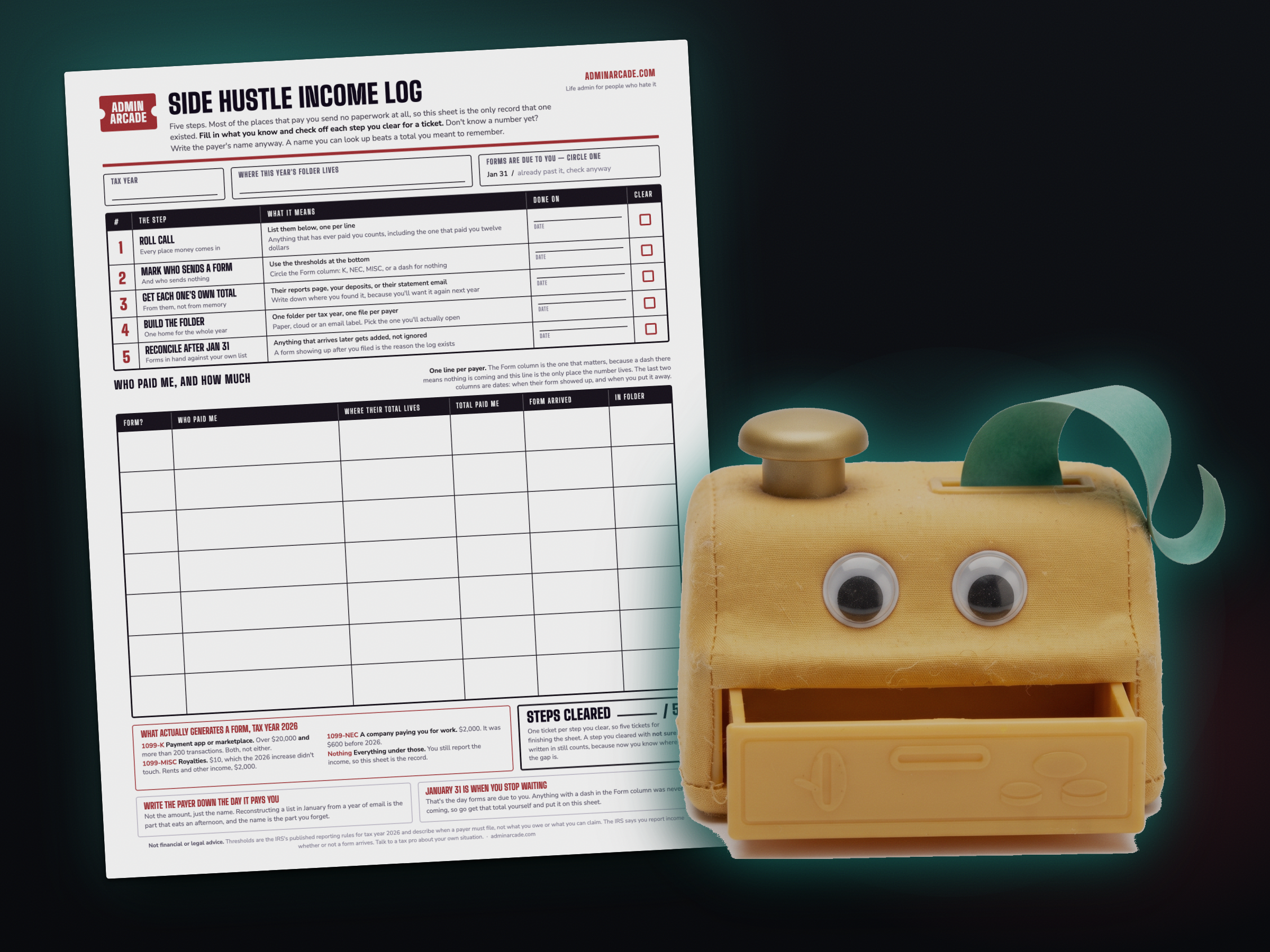
One page, free, no email required. The top is the five steps with a box to check off each one. The middle is a seven row grid for who paid you, where their total lives, the amount, and whether a form arrived. The bottom has the thresholds printed on the sheet, so you can mark the form column without looking anything up.
There's a line at the top for the tax year and one for where this year's folder lives, so the sheet says where the files are.
Write the name down the day the money lands. The amount will still be sitting in their dashboard next January. A payer you used once in May is the one you'll forget, so the name is the part to catch while it's in front of you.
Clear all five steps and you've earned five tickets and Ledger Louie, who is the prize on this one. Nothing expires and there's no streak to lose, so a sheet you start in April and finish in November still pays the same five.

Ledger Louie has a paper version. The Prize Counter is a blank sheet of twelve circles you print once and keep, and the prize stickers are the ones you cut out and stick on it. Both are free on one page, and that page always has the newest prizes.
Did the five steps on paper instead of in the tool? That still counts. Nothing on this site is locked behind a sticker, and the tally only ever goes up.
Not financial or legal advice. The thresholds here are the IRS's published rules for when a payer has to file, and they don't tell you what you owe or what counts as an expense. For your own situation, talk to a tax pro.
Questions people ask
Do I have to report income if I didn't get a 1099?
Yes. The IRS puts it on their own 1099-K page: "Whether or not you receive a Form 1099-K, you must still report any income on your tax return." A form is a filing a payer makes about you, and it was never what created the obligation.
If a client pays me through PayPal, who sends the 1099?
PayPal, not the client. The IRS instructions say third-party network transactions "must be reported on Form 1099-K by the payment settlement entity" and "are not subject to reporting on Form 1099-MISC or Form 1099-NEC." The client files nothing however much they sent, and PayPal files only if your account passes $20,000 and 200 transactions. That form is one total with no breakdown by client.
What is the 1099-NEC threshold for 2026?
$2,000. The IRS says "For payments made before 2026, the reporting threshold is $600. For payments made in 2026, the reporting threshold is $2,000," adjusted for inflation after 2026. A client paying you $1,500 directly files nothing this year, where the same work would have generated a form a year earlier.
When are 1099s supposed to arrive?
January 31. That's the date payers have to furnish your copy of the 1099-NEC and the 1099-MISC. After it, stop waiting on anything that hasn't shown up and go get that total yourself.
What do I do if a 1099 shows up after I've already filed?
Add it to your log first, so the record is complete whatever happens next. Late arrivals are ordinary, especially from smaller payers. What to do about a return you've already filed depends on your situation, and that's one for a tax pro rather than a printable.
How long should I keep side hustle records?
The IRS gives a period of limitations rather than one number. The general answer is 3 years from the date you filed, running to 6 years when unreported income tops 25% of the gross income shown on the return, with no limit at all if no return was filed. Three years covers a folder like this.
A tool I built
Side Hustle Garden
Log every side hustle payment and watch it knock out your monthly bills, smallest first.
Plant your first dollar →I run an affiliate program on the tools I build. Approved affiliates earn 20% on what their referrals pay, for up to a year. US only for now. See the program →