Donation Receipt Log: What Proof Each Gift Needs
A donation receipt log is one list of every charity gift you made this year, with the proof each one needs. Any cash gift needs a bank or card record, or a receipt from the charity with its name, the date and the amount. A single gift of $250 or more also needs a letter from the charity before you file. Dropped-off stuff needs a receipt or your own notes. The free log and tool below sort it for you.
Why I needed a donation receipt log
I donate to all kinds of places, pretty randomly, and I don’t get receipts. So I don’t even know how to track it.
My husband gets an itemized list at the end of the year for his donations. Not every place sends one, though. For mine, I either go through receipts or scroll my credit card statements.
And the stuff I drive around and drop off? It doesn’t get counted at all.
This year more people need the list. Starting with 2026 gifts, you can deduct up to $1,000 of cash gifts, or $2,000 married filing jointly, even if you take the standard deduction. The IRS spells it out in Publication 6196.
What records do you need for charitable donations?
It depends on how you gave and how much. Cash gifts need a bank record or a receipt, any single gift of $250 or more needs a letter from the charity, and over $500 in stuff for the year adds Form 8283. Here’s the whole set on one table.
| How you gave | Proof you need | Watch for |
|---|---|---|
| Cash, check, card or online, under $250 | A bank or card statement, canceled check, or a receipt from the charity with its name, the date and the amount | Any amount needs proof, even $5 |
| One cash gift of $250 or more | A letter or email from the charity with the amount and whether you got anything back | Have it in hand before you file |
| Paycheck deduction | Your pay stub or W-2, plus a pledge card from the charity | Each paycheck counts as its own gift |
| Event, dinner or auction | The charity’s statement of what you got, when you paid over $75 | Only the part above that value counts |
| Clothes or household items under $250 | A receipt from the charity, or your own notes for an unattended drop box | Good used condition or better |
| Stuff worth $250 to $500 | A letter from the charity describing what you gave | No value needed on the letter |
| Stuff over $500 for the year | Form 8283 with your return | Over $5,000 needs an appraisal too |
| Car, boat or plane over $500 | Form 1098-C from the charity | The charity sends it within 30 days of selling it |
| Stock or other securities | A letter from the charity for $250 or more, plus a note of the company, the type of share and whether it’s publicly traded | Over $500 means Form 8283. Publicly traded shares don’t need an appraisal |
| IRA gift sent straight to a charity, age 70½ or older | The same letter from the charity you’d need for a deduction | It stays out of your income, so you can’t deduct it too |
| Volunteer driving | Your own log of the charity, dates and miles | 14 cents a mile, plus parking and tolls |
| Volunteer costs you paid yourself | Your receipts, plus a letter from the charity describing what you did when the costs reach $250 or more | Only costs tied directly to the volunteering count |
The job breaks into five stations. Each one pays a ticket, and you can stop after any of them.
- List every gift from this year.
- Match each gift to the proof it needs.
- Ask for the letters you’re missing.
- Write up your drop-offs and drives.
- Set aside what doesn’t count.
Station 1: List every gift from this year
One line per gift. Places to look:
- Bank and card statements. Search for the charity names you remember, then scroll for the ones you don’t.
- Year-end letters and thank-you emails. Search your inbox for “donation” and “thank you for your gift.”
- Pay stubs, if you give through work.
- Brokerage and IRA statements, if you gave shares or gave straight from an IRA.
- Your phone bill, for text-to-give. It counts in the year you send the text.
- Your memory of every drop-off. Clothes, a lamp, a box of books. Write down where and roughly when.
Timing gets confusing at the end of December. A gift on your credit card counts in the year you charge it, even if you pay the bill in January. A check counts on the day you mail it.
Station 2: Match each gift to the proof it needs
Go down your list and check each gift against the table above. Check off the ones where the proof is already in hand.
The $250 line is per gift, not per charity. Five $50 gifts to the same food bank stay five small gifts, and a statement covers each one.
Text-to-give is the odd one. The IRS list of bank records in Publication 526 doesn’t include a phone bill, so ask the charity for an email receipt.
Station 3: Ask for the letters you’re missing
Any single gift of $250 or more needs a written acknowledgment from the charity. You need it by the day you file, or by your due date with extensions if that comes first. Without it, the gift can’t be deducted.
The letter has to show the amount and say whether you got anything back for it. If you did, it gives a good faith value. One year-end summary can cover several gifts if it lists each one with its date.
Ask the charity to email one. Something like:
“Hi, I gave [amount] on [date]. Could you email me a receipt for my taxes with the amount, the date, and whether I got anything in return? Thank you.”
Put the letters with the rest of your tax papers. The tax document checklist has a line for donation receipts so they don’t get left behind in January.
Station 4: Write up your drop-offs and drives
Here your own notes do the work.
- Left it in a drop box with nobody there? Your own written record counts. Note what it was, its condition, what it was worth, and how you came up with that number.
- Clothes and household items have to be in good used condition or better.
- Value it at what it would sell for used. Publication 561 points to prices at thrift and consignment shops, which is far less than what you paid.
- Over $500 in stuff for the year? You’ll file Form 8283 with your return. One item or group worth over $5,000 needs a written appraisal.
- Drove for a charity? Log the date, the charity and the miles. The rate is 14 cents a mile, set by law, plus parking and tolls. Your time doesn’t count, only the costs.
- Spent your own money volunteering? Keep the receipts. Costs of $250 or more also need a letter from the charity describing what you did for it.
If you’re not sure whether a piece belongs in the donation bag or should get listed for sale, the resell-or-donate rule on Seeding Serendipity sorts that out. If it’d take more time to list than it’d probably sell for, it goes in the bag.
Station 5: Set aside what doesn’t count
Look up each place in the IRS Tax Exempt Organization Search and pick the Pub. 78 data. Some churches don’t show up in it and can still qualify, so a missing church isn’t a no.
These never count, per the IRS and Publication 526:
- Gifts to a person, including a fundraiser page for someone
- Political campaigns, parties and groups
- Raffle, bingo and lottery tickets, even when a charity runs them
- The value of your volunteer time
Keep them on your log anyway, marked as not counting, so you’re not wondering in April whether you forgot them.
What changed for donations in 2026?
A 2025 law changed charity deductions starting with the 2026 tax year, so it shows up on the return you file in 2027.
- If you don’t itemize: you can deduct up to $1,000 of cash gifts, or $2,000 married filing jointly. Dropped-off stuff doesn’t count toward it, and neither do gifts to donor-advised funds.
- If you itemize: only the part of your gifts above 0.5% of your adjusted gross income counts.
The IRS hasn’t published the 2026 version of Publication 526 yet, so check it before you file. The proof rules on this page come from the 2025 edition.
Fill it in with the donation receipt log tool
Add each gift with the charity, date, how you gave and the amount. The tool tells you what proof each one needs, lists the letters to ask for, figures your volunteer miles, and adds up cash gifts, stuff and driving separately. Print the finished log when you’re done.
Nothing you type leaves your browser. The tool has no account, no login, and no server to send anything to.
The printable donation receipt log
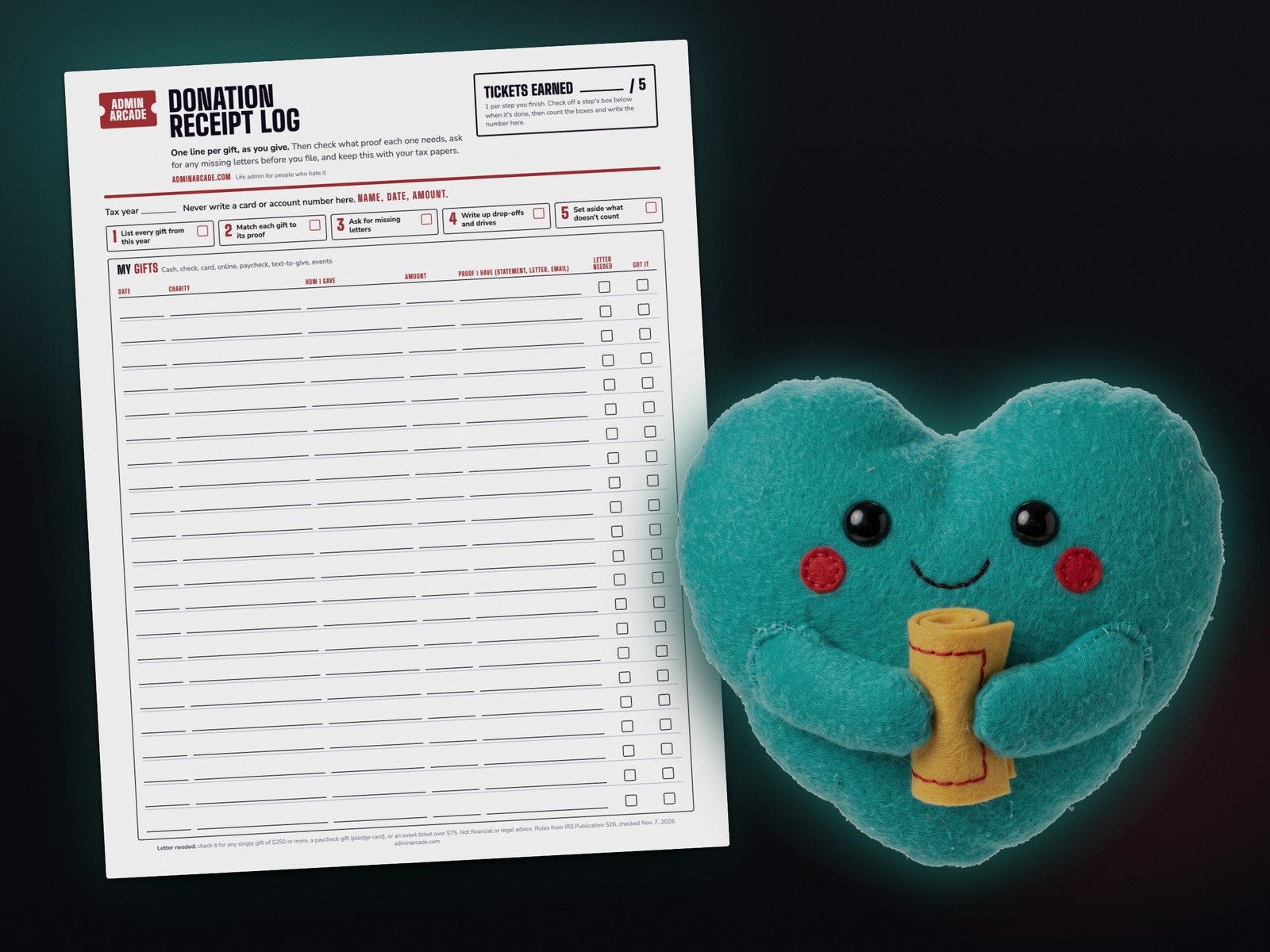
Two pages, free, no email required. Page one has 22 lines for gifts, with boxes for whether you need a letter and whether you got it. Page two has a drop-off log with a good-used-condition box, a mileage log, and the proof table in short form.
Two rules so the log gets filled in
Write the line the day you give. A drop-off you log in the parking lot takes a minute. The same drop-off in April is a guess.
Keep the log and the letters with your return. The IRS general rule is 3 years, and the keep-or-shred guide has the longer cases. A folder labeled with the tax year works, and the home filing system already has a spot for it.
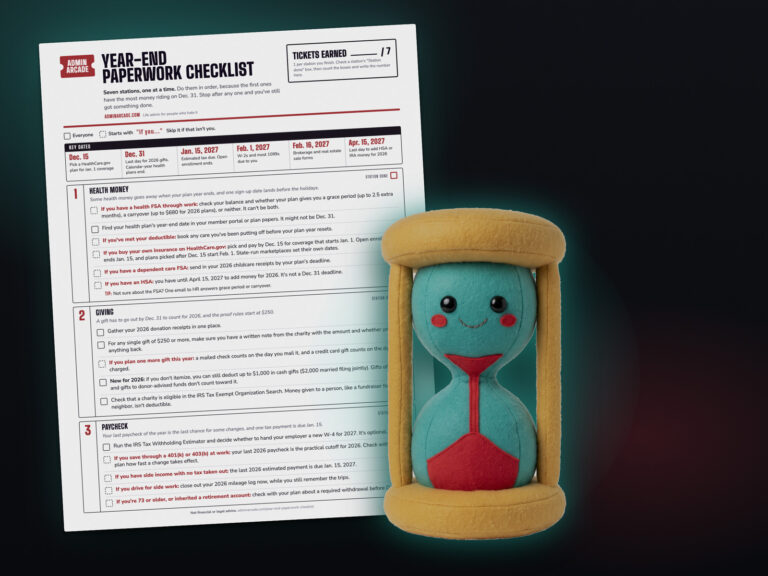
Finish all five stations and you've earned five tickets and Hearty Hank, the prize on this one. Nothing expires and there's no streak to lose, so a log you fill in over a few evenings pays the same five.

Frequently asked questions
Do I need a receipt for every donation?
You need proof for every cash gift, but it doesn't have to be a receipt. A bank or card statement showing the charity's name, the date and the amount works under $250. A single gift of $250 or more needs a letter or email from the charity.
What does a donation receipt need to say?
For a gift of $250 or more, the charity's letter shows the amount, or describes the stuff you gave, and says whether you got anything back. If you did, it gives a good faith value of it. It doesn't need your Social Security number.
Can I deduct donations if I don't itemize?
Starting with 2026 gifts, yes. You can deduct up to $1,000 of cash gifts, or $2,000 married filing jointly, with the standard deduction. Dropped-off stuff and gifts to donor-advised funds don't count toward it.
Do I need a receipt for dropping off donated clothes?
Get one if someone's there to give it to you. If you left it in an unattended drop box, your own written record works: what it was, its condition, its value and how you figured the value. Clothes have to be in good used condition or better.
Are donations to a fundraiser for a person deductible?
No. The IRS says gifts to individuals, including individual fundraising accounts, aren't deductible, even when the cause is a good one.
Is the donation receipt log free?
Yes. The printable and the tool are both free, with no email required. Not financial or legal advice.
Not financial or legal advice. I'm not a tax pro, so ask one about your own return.
A book I made
The Lightest One
An undated ADHD daily book that never asks you to prioritize. Dump everything in your head, mark each thing light, medium or heavy, and do the lightest one.
Get the paperback →I run an affiliate program on the tools I build. Approved affiliates earn 20% on what their referrals pay, for up to a year. US only for now. See the program →