Year-End Paperwork Checklist: 7 Stations Before Dec. 31
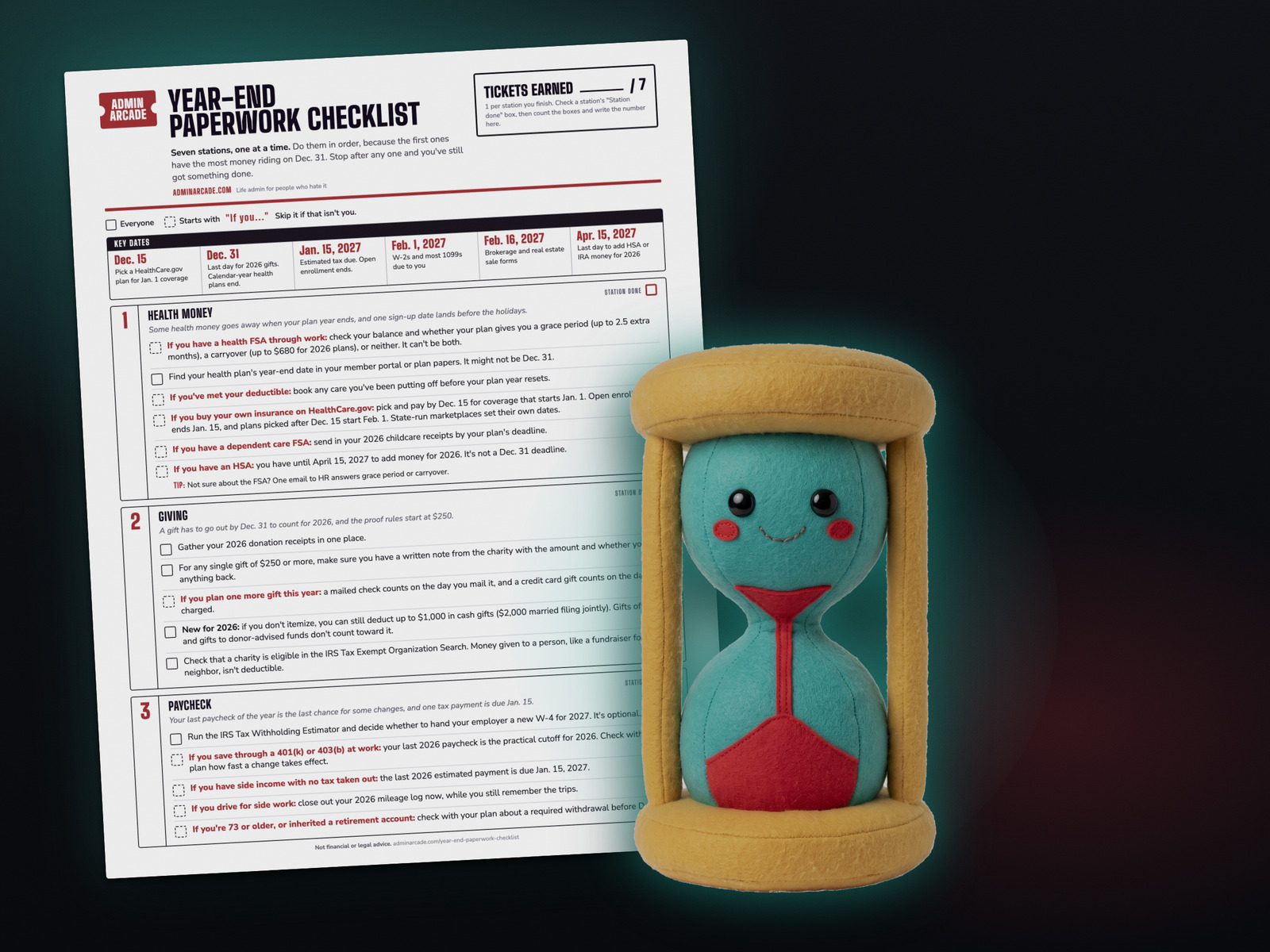
A year-end paperwork checklist covers the money with a Dec. 31 deadline first: health FSA dollars (carryover tops out at $680 for 2026 plans), donations (they have to go out by Dec. 31 to count), and HealthCare.gov sign-ups (Dec. 15 for Jan. 1 coverage). Then it gets your address, wallet, renewals and files ready for tax forms due Feb. 1, 2027. This free checklist splits it into seven short stations you can stop between.
What should you do with paperwork before the end of the year?
Catch the things with a deadline first. Most of this list can wait until January without costing anything. A few items can’t, and those are the ones where money goes away if Dec. 31 slips by.
So the seven stations go in order of what’s at stake. The first three cover money with a hard date. The last four set up January, so tax season has fewer surprises.
Each station is short, pays one ticket, and stands on its own. Do one tonight and stop, and you’re still better off than you were. If an item doesn’t apply to you, mark it and move on. A lot of them start with “if you have,” and skipping those is the point.
- Health money. FSA balance, plan year, HealthCare.gov, Medicare.
- Giving. Receipts and the Dec. 31 cutoff.
- Paycheck. Withholding, the last paycheck, the Jan. 15 payment.
- Wallet sweep. Gift cards and points.
- Address and identity. Before the tax forms go out.
- Car and home renewals. Registration, license, insurance.
- Paper purge and the new folder. Shred, then set up for 2027.
What are the year-end deadlines for 2026 and early 2027?
| Date | What’s due | Who it’s for |
|---|---|---|
| Dec. 7, 2026 | Last day to change Medicare plans for Jan. 1 | Anyone on Medicare |
| Dec. 15, 2026 | Pick and pay for a HealthCare.gov plan to start Jan. 1 | Anyone buying their own insurance |
| Dec. 31, 2026 | Last day for a gift to count for 2026 | Anyone who gives to charity |
| Dec. 31, 2026 | End of the plan year for calendar-year health plans and FSAs | Check your plan, yours might differ |
| Jan. 15, 2027 | Last 2026 estimated tax payment. HealthCare.gov open enrollment ends | Side income with no tax taken out |
| Feb. 1, 2027 | W-2s and most 1099s due to you | Everyone who files |
| Feb. 16, 2027 | Brokerage and real estate sale forms due to you | Anyone who sold stocks or property |
| Apr. 15, 2027 | Last day to add 2026 money to an HSA or IRA | Anyone with one |
Jan. 31, 2027 lands on a Sunday, which is why the W-2 date moves to Monday, Feb. 1. A form mailed or posted online by its due date counts as on time, so give the mail a few days before you chase one.
Station 1: Health money, FSA and plan year
- If you have a health FSA through work: check your balance and your plan’s rule. Your employer can give you a grace period of up to 2½ extra months, or a carryover, or neither, but never both, per HealthCare.gov. The carryover tops out at $680 for plans starting in 2026, according to the IRS 2026 inflation release.
- Find your plan’s year-end date. HealthCare.gov says a job-based plan year doesn’t always match the calendar year, so look in your member portal or plan papers instead of assuming Dec. 31.
- If you’ve already met your deductible: book any care you’ve been putting off before your plan year resets.
- If you buy your own insurance on HealthCare.gov: pick a plan and pay the first premium by Dec. 15 for coverage starting Jan. 1. Open enrollment ends Jan. 15, and plans picked after Dec. 15 start Feb. 1, per its dates page. States running their own marketplace set their own dates.
- If you have Medicare: open enrollment runs until Dec. 7. That’s the last day to switch plans or add or drop drug coverage for Jan. 1, per Medicare.gov.
- If you have a dependent care FSA: send in your 2026 childcare receipts by your plan’s deadline.
- If you have an HSA: no rush. IRS Pub. 969 lets you add 2026 money until April 15, 2027.
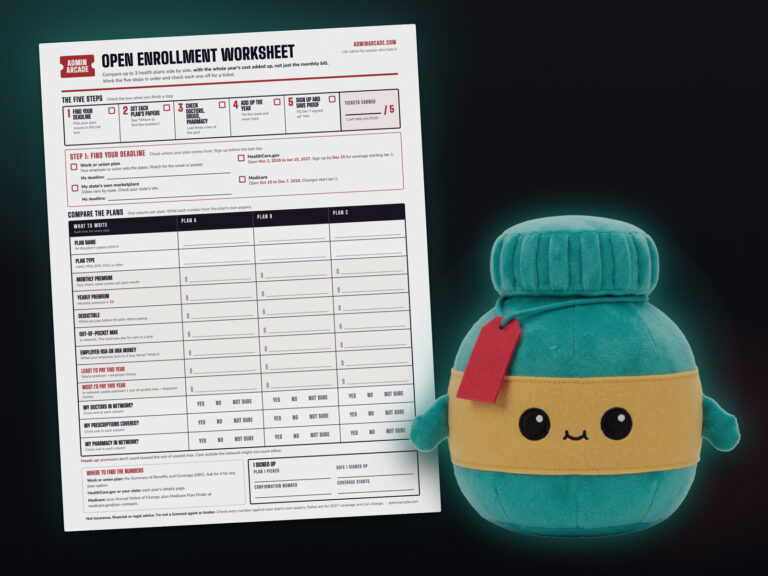
Marked “not sure” on the FSA rule? One email to HR answers grace period or carryover. If you’re comparing plans for next year, the open enrollment worksheet lines up three plans side by side.
Station 2: Donation receipts and the Dec. 31 cutoff
A gift has to go out by Dec. 31 to count for 2026, and the proof you need depends on the size of the gift.
- Gather your 2026 donation receipts in one place, including bank records for cash gifts.
- For any single gift of $250 or more, you need a written note from the charity with the amount and whether you got anything back, per IRS Topic 506. Get it before you file.
- Giving one more time this year? A mailed check counts on the day you mail it, and a credit card gift counts on the day it’s charged, per IRS Pub. 526.
- New for 2026: if you take the standard deduction, you can still deduct up to $1,000 in cash gifts, or $2,000 married filing jointly, according to the IRS. Gifts of stuff and gifts to donor-advised funds don’t count toward it.
- Check the charity in the IRS Tax Exempt Organization Search. Money given to a person, like a fundraiser for a neighbor, isn’t deductible.
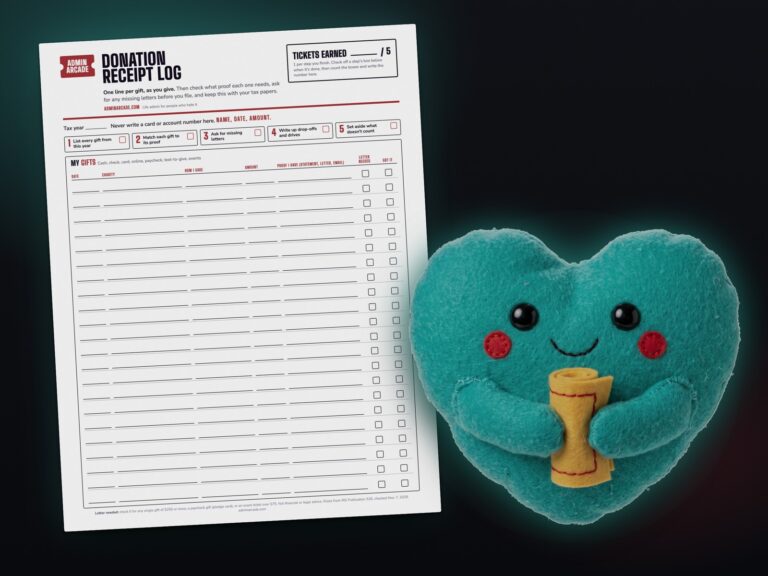
The donation receipt log has a line for every gift and a column for the acknowledgment, so the $250 ones are easy to spot.
Station 3: Paycheck, withholding and the Jan. 15 payment
Your last paycheck of the year is the cutoff for a couple of changes, and one tax payment lands in mid-January.
- Run the IRS Tax Withholding Estimator and decide whether to hand your employer a new W-4 for 2027. It’s optional, and the tool fills one out for you.
- If you save through a 401(k) or 403(b) at work: your last 2026 paycheck is the practical cutoff for 2026. Ask your plan how fast a change takes effect.
- If you have side income with no tax taken out: the last 2026 estimated payment is due Jan. 15, 2027, per the IRS.
- If you drive for side work: close out your 2026 mileage log while you still remember the trips. The IRS rate changed midyear, from 72.5 cents a mile through June to 76 cents from July 1.
- If you’re 73 or older, or inherited a retirement account: check with your plan about a required withdrawal before Dec. 31.
Side income? The side hustle income log keeps the year’s payments on one page for tax time. Running a side business? Jen8n has a walkthrough of a bookkeeping setup that sorts a year of expenses by Schedule C line.
Station 4: Do gift cards and points expire?
Fees on a gift card can start after 12 months of not using it, per the CFPB. Points and card credits each have their own rules.
- Find every gift card in your wallet, junk drawer and email, and check each balance.
- Open each rewards app (airline, hotel, store, credit card) and look for points or credits with an end date.
- Check card benefit credits for any tied to the calendar year.
Under federal rules, the money on a gift card can’t expire until at least five years after it was bought or last loaded. If the card itself expires with money still on it, the issuer can’t charge you for a replacement. The junk drawer counts as a wallet for this station.
Station 5: Address and identity before the tax forms go out
W-2s and most 1099s are due to you by Feb. 1, so anyone sending one needs your current address before then.
- If you moved in 2026: update your address with your employer, bank and anyone else who sends you a tax form. Tell the IRS too, with Form 8822 or a letter. The IRS says to do it even if you filed a change of address with the post office.
- Pull your free credit reports. The FTC says all three bureaus give them free every week at AnnualCreditReport.com.
- Decide on a credit freeze. It’s free, doesn’t touch your score, and stays on until you lift it, per the FTC.
- Put “get my IRS IP PIN” on your mid-January calendar. The IRS online tool is offline from Nov. 16, 2026 until mid-January.
Moved this year? The change of address checklist has every place to update in one list.
Station 6: When do car registration and insurance renew?
None of these has one national date. Your state’s DMV sets registration and license dates (USA.gov links to every state), and your county sets property tax dates, so the only way to know is to look.
- If you drive: check your registration sticker and your license expiration date.
- Check your car, renter’s or home insurance renewal dates. If you drive, my car accident information form is a one-page sheet for the glovebox, so it can ride along with the new insurance card.
- If you own a home: check your county’s property tax due dates.
- Put anything renewing in January or February on your calendar now.
For everything else with a renewal date, the things that expire list has a station for each kind.
Station 7: What to shred, and the folder for 2027
Clearing out old paper now means January’s tax forms have one folder to go in.
- Shred what’s past the IRS keep window. The IRS says 3 years for most tax records. It’s 6 years if you left off income worth more than 25% of the gross income on that return, and 7 years if you claimed a loss on worthless securities or a bad debt. Keep copies of every return you filed.
- Start a folder for the 2026 tax year and put it somewhere you’ll see it in January. If the folder needs a home with a lock, I reviewed a fireproof document holder with 13 pockets over on Jen Tried It.
- Write down what’s coming: W-2s, most 1099s and the 1098s (mortgage interest, student loan interest, tuition) by Feb. 1, 2027, brokerage and real estate sale forms by Feb. 16, 2027.
- If you had a HealthCare.gov plan in 2026: add Form 1095-A to the list. It’s due to you by Feb. 1, 2027, per the IRS.
- Won a sweepstakes prize this year? Prizes count as income, and one worth $2,000 or more can show up on a 1099-MISC, so that form goes in the folder too.
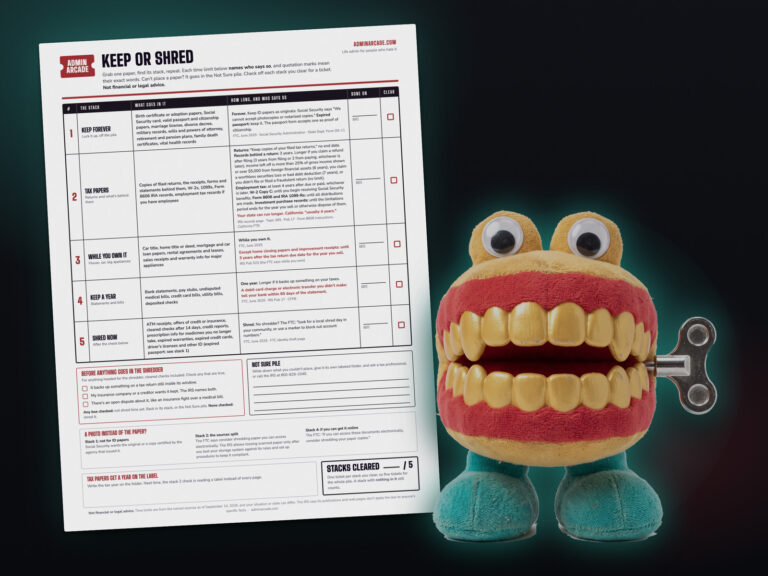
Not sure what’s safe to shred? Keep or shred goes paper by paper. The tax document checklist lists which forms to expect, so a missing one is obvious in February.
Do the checklist with the year-end sweep tool
Go station by station and mark each item done, doesn’t apply, or not sure. At the end, the tool lists every not sure and every station you skipped, so you know exactly what’s left. Your answers stay in this browser, and you can come back to them.
Nothing you type leaves your browser. The tool has no account, no login, and no server to send anything to.
The printable year-end paperwork checklist
Free, no email required. It has all seven stations with a box for every item, the key dates from Dec. 7 to April 15, and a space to write down every not sure. Print at actual size, 100%.
The Admin Arcade advent calendar opens Dec. 1 with more year-end sheets behind its doors, if one checklist isn't enough paper for you.
Two rules so the checklist gets finished
Do the first three stations before Dec. 15, or before Dec. 7 if you're on Medicare. They're the only ones with money on a deadline. The rest can spill into January without costing you anything.
Write down every not sure and keep going. One question for HR or a charity shouldn't stop the whole checklist. The not-sure list becomes a short to-do for the next workday.
Finish all seven stations and you've earned seven tickets and Hourglass Hal, the prize on this one. Nothing expires and there's no streak to lose, so seven stations spread over seven nights pays the same seven.

Frequently asked questions
What should I do before the end of the year financially?
Start with anything on a Dec. 31 deadline: spend or check the rules on your health FSA, make any 2026 donations, and pick a HealthCare.gov plan by Dec. 15 if you buy your own insurance. Then check your withholding and set up a folder for tax forms due Feb. 1, 2027.
Do donations have to be made by Dec. 31 to count?
Yes, for the 2026 tax year. IRS Pub. 526 says a mailed check counts on the day you mail it and a credit card gift counts on the day it's charged, even if you pay the card bill in January.
What happens to FSA money at the end of the year?
It depends on your plan. HealthCare.gov says an employer can offer a grace period of up to 2½ months or a carryover, but not both, and doesn't have to offer either. For 2026 plans, the carryover limit is $680.
Can I deduct donations if I don't itemize?
Starting with 2026, yes, up to $1,000 in cash gifts, or $2,000 married filing jointly, according to the IRS. Gifts of things and gifts to donor-advised funds don't count.
When will I get my W-2 for 2026?
Employers have until Feb. 1, 2027 to send it, because Jan. 31 falls on a Sunday. Most 1099s share the same date, and brokerage forms are due by Feb. 16, 2027.
When does Medicare open enrollment end?
Dec. 7. Medicare.gov says fall open enrollment runs Oct. 15 to Dec. 7, and a change made by then starts Jan. 1. If you're already in a Medicare Advantage plan, a second window runs Jan. 1 to March 31.
Not financial or legal advice. Dates and limits come from the IRS, HealthCare.gov, the FTC, the CFPB and Medicare.gov, read Nov. 14, 2026. Your plan, employer or state can set different rules, so check yours.
A book I made
The Lightest One
An undated ADHD daily book that never asks you to prioritize. Dump everything in your head, mark each thing light, medium or heavy, and do the lightest one.
Get the paperback →I run an affiliate program on the tools I build. Approved affiliates earn 20% on what their referrals pay, for up to a year. US only for now. See the program →