Lost Wallet Checklist: What to Cancel First (Free Printable)
If your wallet is lost or stolen, call the bank behind your debit card first, then every credit card issuer, because debit losses can grow from $50 to $500 after two business days. Next, freeze your credit at Equifax, Experian and TransUnion. Then report your driver’s license to your state DMV, replace your health and benefit cards, and update your autopays when the new cards arrive. The free lost wallet checklist below puts every number in one place.
Why fill in a lost wallet checklist before you need it?
The phone number for reporting a lost card is printed on the back of the card. The one in the wallet you can’t find.
The FTC suggests saving each card company’s customer service number in your phone contacts and keeping it current. This sheet does the same job on paper, for everything in the wallet, not only the cards. Name and phone number for each one, never the card number, so the sheet is useless to anyone who finds it.
Stop after any station and you’re still ahead.
Lost credit card vs lost debit card: how much do you owe?
Debit goes first because the money comes straight out of your checking account, and what you owe depends on how fast you call.
| When you report it | Credit card | Debit or ATM card |
|---|---|---|
| Before anyone uses it | $0 | $0 |
| Within 2 business days of noticing | Up to $50 | Up to $50 |
| After 2 business days | Up to $50 | Up to $500 |
| More than 60 days after your statement | Up to $50 | Everything taken, possibly from linked accounts too |
What to do if you lose your wallet, in order
The job breaks into five stations. Each one pays a ticket.
- Call your card issuers: debit cards first, then credit.
- Freeze your credit: all three bureaus, or a fraud alert at one.
- Report your driver’s license or ID: your state DMV, plus a police report if your state ties the ID to one.
- Replace your other cards: health insurance, Medicare and benefit cards.
- When the new cards arrive: update autopays and carry less.
Station 1: Call your card issuers, debit cards first
Call the bank on each debit card, then each credit card. Use a number you know is real, from your sheet, a statement or the bank’s app, never one from a surprise text.
- Cancel the card and ask for a new one. Then check your recent transactions.
- Write down who you talked to and when. The FTC says to follow up with a letter and keep a copy, and the CFPB says a bank can ask for written confirmation within 10 business days of a phone report.
- Ignore anyone selling card loss protection. The FTC calls those calls and texts scams.
- Checks too? Ask your bank to stop payment. IdentityTheft.gov also lists two check verification companies, TeleCheck (1-800-710-9898) and Certegy (1-800-437-5120).
- Benefits on a Direct Express card? Call 1-888-741-1115 if the card number starts with 5332, or 1-833-347-9777 if it starts with 5141. Both answer around the clock.
Phone went with the wallet? On an iPhone, Mark as Lost in Find My locks the phone and suspends Apple Pay. On Android, Find Hub at android.com/find can mark the phone as lost or erase it. Do it from a borrowed phone or a computer first.
Station 2: Should you freeze your credit or place a fraud alert?
A credit freeze stops anyone, you included, from opening new credit in your name until you lift it. It’s been free at all three bureaus since Sept. 21, 2018. Online and phone freezes have to be placed within 1 business day, and a lift within 1 hour.
| Bureau | Phone | Freeze page |
|---|---|---|
| Equifax | 800-685-1111 | Equifax freeze |
| Experian | 888-397-3742 | Experian freeze |
| TransUnion | 888-909-8872 | TransUnion freeze |
You place a freeze at each bureau, one at a time. A fraud alert is the one-call option. You contact one bureau, it has to tell the other two, and lenders then have to check it’s you before opening new credit. The FTC says an initial fraud alert lasts 1 year and you can renew it.
Already seeing charges or accounts you didn’t make? IdentityTheft.gov splits the steps by whether your info has been used yet. If it has, report it there or at 1-877-438-4338 and the site builds a recovery plan for you.
Station 3: Report your lost driver’s license or state ID
Call or visit your state’s DMV. IdentityTheft.gov says the state might flag your license number or suggest a duplicate. USA.gov lists every state DMV.
Federal pages leave a police report up to you. Some states tie the ID to one:
- Texas: a duplicate costs $11. If someone else used your stolen card, Texas DPS says you have to file a police report and bring a copy.
- New York: a replacement is $17.50, or free with form MV-78B if the license was lost to a crime. Only police agencies hand out the MV-78B.
- California: you can start a license replacement online. An ID card needs an office visit too, and the new card comes by mail in 3 to 4 weeks.
Rules and fees change from state to state, so check your own DMV’s page before you go.
Station 4: Replace your health, Medicare and benefit cards
Then call about everything else in the wallet:
- Health insurance: the number’s on your statements.
- Medicare: print a new card from your Medicare.gov account, or call 1-800-633-4227 to get one mailed.
- Medicaid or SNAP EBT: your state or local office.
- Passport card: the State Department, 1-877-487-2778.
- Green card: file Form I-90 with USCIS to replace it. You can file online, and USCIS answers questions at 800-375-5283.
- VA health card: get a replacement by phone, online through AccessVA or at your nearest VA medical center. Bring a government ID if you go in person.
- Military ID: for a lost CAC, report it to your local security office or CAC sponsor first. The DoD’s CAC site says you’ll need their paperwork confirming it’s lost or stolen to get a new one. For a Uniformed Services ID card, go to the nearest RAPIDS site for a new one.
- Store, library, transit and gift cards: call each one, say it’s lost and ask what they can do. The FTC suggests keeping a photo of each gift card and its receipt, which only helps if you took it before.
Do you need a new Social Security card?
Often not. Social Security says you might not need a replacement if you know your number. If you do need one, it’s free, it comes by mail in 5 to 10 business days, and you get 3 a year and 10 in a lifetime.
Worried someone has the number? The IRS gives out a free Identity Protection PIN, a six-digit code to stop anyone else filing a tax return with your number.
Station 5: Update your autopays when the new cards arrive
If the new card has a new number, every bill charged to the old one needs it. The CFPB and IdentityTheft.gov both say to update them. The printable autopay list is a list of exactly those bills, so you’re not waiting for each one to bounce.
Google says your bank might update the card in Google Wallet on its own, but saved online card details might still need changing. On an iPhone, check Wallet and add the new card if it’s missing.
Last, put less back in the wallet:
- Your Social Security card stays home. SSA says knowing the number is usually enough.
- Your debit PIN never goes in the wallet. The FTC says not on a note and not on the card.
- Only the cards you use. The FTC says to carry only the ones you’ll need.
- Your Medicare card might stay in. Medicare.gov says people on Original Medicare should carry it when they’re away from home.
The card worth adding is an emergency wallet card with your medicines, allergies and who to call.
Fill it in with the Wallet Lockdown tool
Pick Fill it in now or My wallet is gone. Add each card by bank or store name, debit or credit, and the number to call, and debit cards move to the top. The three credit bureaus, Medicare and Social Security are already filled in. Check off each call as you make it, and print the finished list.
Nothing you type leaves your browser. The tool has no account, no login, and no server to send anything to. It never asks for a card number.
The printable lost wallet checklist
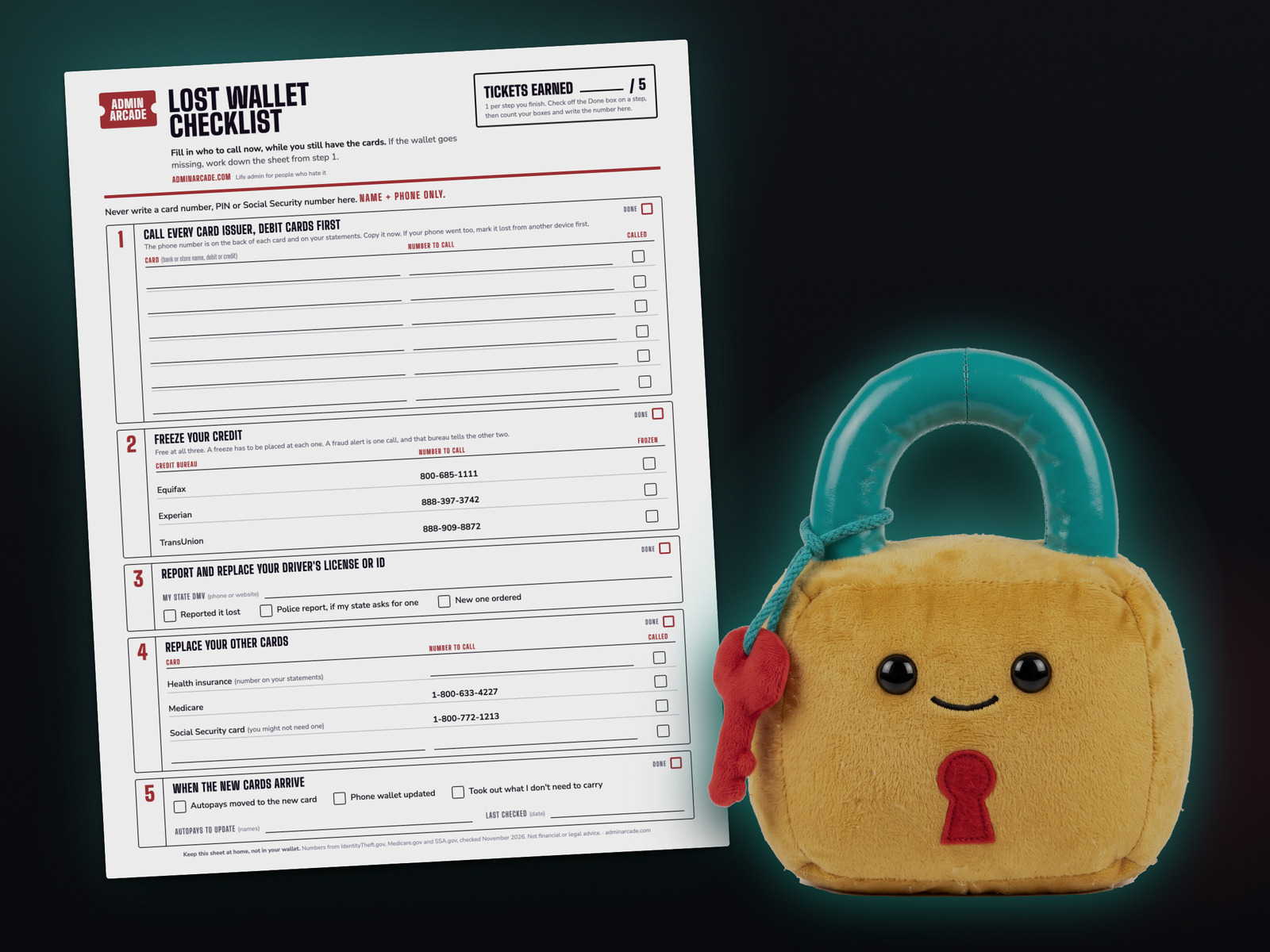
One page, free, no email required. It has six rows for your cards, the three credit bureaus with their numbers printed, a DMV line, and rows for your other cards. Every row gets a box to check when you've called.
Two rules so the sheet's there when you need it
Keep it at home, not in the wallet. A checklist for a lost wallet doesn't do much if it's in the lost wallet. Put it with your important papers, and take a photo so it's on your phone too.
Add a row the day a new card comes in. Name and number, nothing else.
Finish all five stations and you've earned five tickets and Padlock Patty, the prize on this one. Nothing expires and there's no streak to lose, so a sheet you fill in over a few evenings pays the same five.

Frequently asked questions
What should I do first if I lose my wallet?
Call the bank on your debit card first, then each credit card issuer, and ask them to cancel the cards. Debit comes first because the money leaves your account right away and your share can climb from $50 to $500 after two business days. Then freeze your credit.
Should I freeze my credit if I lose my wallet?
It's one of the first steps IdentityTheft.gov lists for lost information. A freeze is free at Equifax, Experian and TransUnion, and you place it at each one. A fraud alert is the one-call option, and the bureau you call has to tell the other two.
Do I need a police report for a lost or stolen wallet?
Federal pages leave it up to you. Some states tie the ID to one, though. Texas says you have to file one if someone used your stolen license, and New York replaces a license lost to a crime for free with a police form.
Do I need to replace my Social Security card?
Often not. Social Security says you might not need one if you know your number. A replacement is free, and you're limited to 3 a year and 10 in a lifetime.
How much am I responsible for if my debit card is stolen?
Nothing, if you report it before anyone uses it. After that, up to $50 if you report within 2 business days and up to $500 after that. More than 60 days after your statement, you can lose everything taken.
Is the lost wallet checklist free?
Yes. The printable and the tool are both free, with no email required. Not financial or legal advice.
A tool I built
Subscription Graveyard
Bury the subscriptions you've canceled, give each one a tombstone, and watch what you're saving pile up.
Bury your first one →I run an affiliate program on the tools I build. Approved affiliates earn 20% on what their referrals pay, for up to a year. US only for now. See the program →