Free Open Enrollment Worksheet: Compare 3 Health Plans
Before you start: This isn’t insurance, financial or legal advice, and I’m not a licensed insurance agent or broker. This worksheet helps you put plans next to each other and do the math. It won’t tell you which plan to pick. Every date and dollar limit below comes from HealthCare.gov, Medicare.gov, CMS, the IRS or the Department of Labor, read October 29, 2026, with a link to each one.
An open enrollment worksheet puts up to three health plans side by side so you can compare what each one costs over a whole year, not only per paycheck. You write down each plan’s monthly premium, deductible and out-of-pocket maximum, check your doctors and prescriptions, and add up your cheapest and most expensive year. For 2027 coverage, HealthCare.gov’s window runs November 1, 2026 to January 15, 2027, and Medicare’s runs October 15 to December 7.
Why compare health plans on paper?
Open enrollment hands you a pile of numbers all at once. A premium, a deductible, copays, coinsurance, an out-of-pocket maximum, a network, a drug list. Each plan has its own version of every one.
The premium is the number you see on every paycheck, so it’s the easy one to compare. It’s also only part of the bill. A plan with a lower premium and a higher deductible can cost less in a quiet year and a lot more in a year with a surgery in it.
What goes on an open enrollment worksheet?
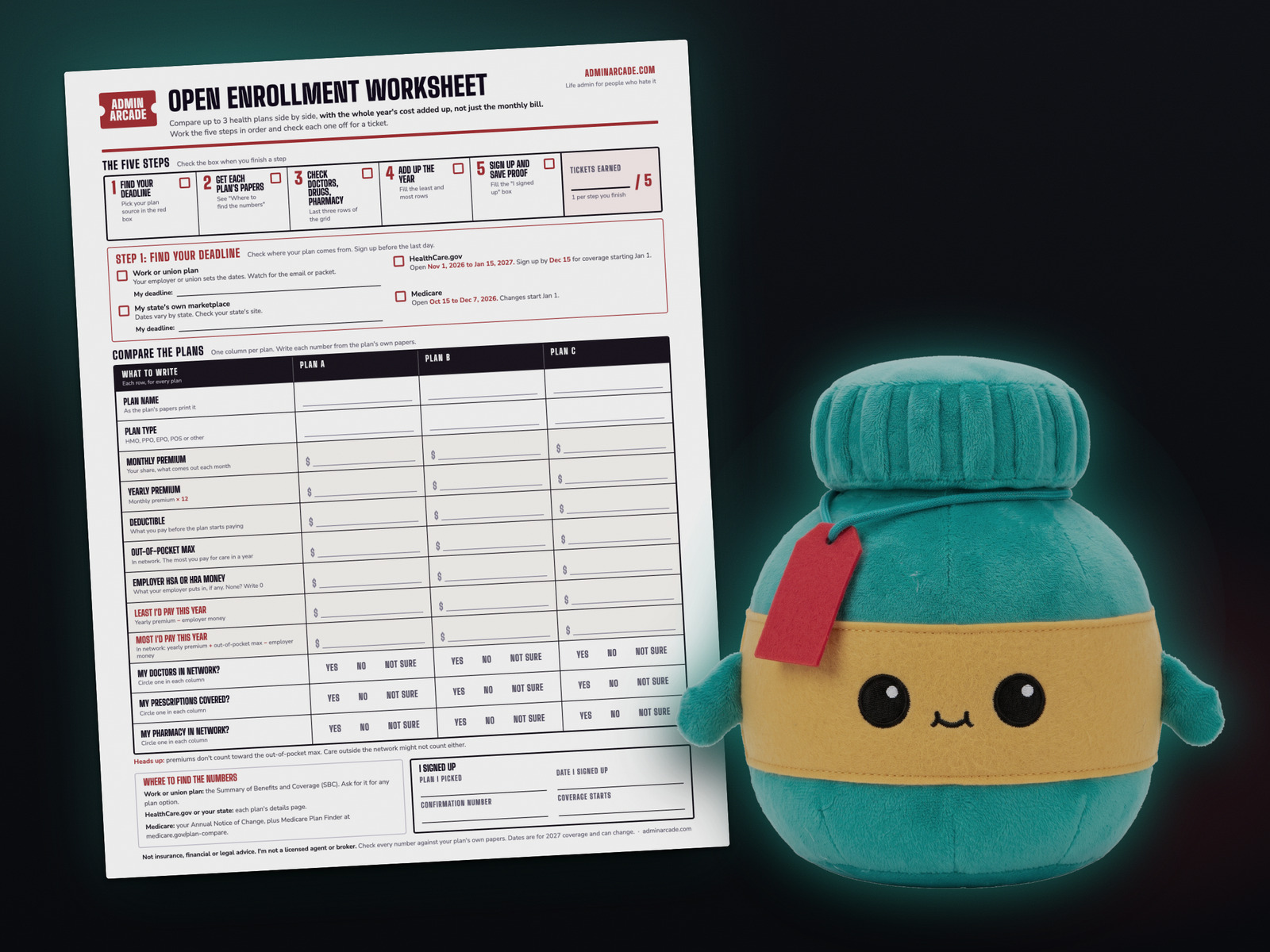
Five steps, one ticket each. You can stop after any of them and pick up later.
- Find your deadline: it depends on where your plan comes from.
- Get each plan’s papers: the plan summary, not the sales page.
- Check your doctors, drugs and pharmacy: in every plan you’re comparing.
- Add up the year: your cheapest year and your worst year, for each plan.
- Sign up and save proof: the confirmation number and the start date.
Step 1: When is open enrollment for my plan?
There isn’t one open enrollment. There are at least four, and each has its own dates.
| Where your plan comes from | Open enrollment for 2027 | To start January 1 |
|---|---|---|
| A job or a union | Your employer or union sets the dates | Check your benefits email or HR |
| HealthCare.gov | Nov 1, 2026 to Jan 15, 2027 | Sign up by Dec 15 |
| Your state’s own marketplace | Set by your state | Check your state’s site |
| Medicare | Oct 15 to Dec 7, 2026 | Changes start Jan 1 |
On HealthCare.gov, signing up between December 16 and January 15 gets you coverage starting February 1. A 2025 federal rule would have ended the window on December 15 starting this year, but a court blocked it in June 2026, and CMS confirmed in August the January 15 end date stands. If you read somewhere the window got shorter, that was written before the ruling.
Already on a Medicare Advantage plan? You get a second window from January 1 to March 31. Medicare.gov says you can switch to a different Medicare Advantage plan then, or drop it and go back to Original Medicare and add a drug plan. The new coverage starts the first of the month after the plan gets your request.
States running their own marketplace pick their own dates. California and New York go to January 31, and Massachusetts opened October 23 and runs to January 23. HealthCare.gov’s state page tells you which site is yours.
A few kinds of coverage run on their own calendar. Medicaid and CHIP take applications any time of year. Federal employees and retirees get Federal Benefits Open Season, November 9 to December 14, 2026. TRICARE’s open season runs November 9 to December 8, 2026, for Prime and Select, and changes start January 1.
Write your deadline at the top of the worksheet, and put it in your phone too. The renewals list is a good home for it, since it comes back every fall.
Step 2: Where do I find each plan’s details?
Every kind of plan has one official summary. Use it instead of the brochure.
- A job or union plan: the Summary of Benefits and Coverage, or SBC. The federal rule says it has to come with your enrollment materials, and you can ask for the SBC for any plan option you’re eligible for. The plan has 7 business days to send it.
- HealthCare.gov or a state marketplace: each plan’s details page on the site, plus its SBC link.
- Medicare: the Annual Notice of Change your plan sends by the end of September, and Medicare Plan Finder, which compares plans and estimates a year of drug costs for your own prescriptions.
One catch with the SBC: it leaves out the premium. The Department of Labor’s template says the premium is provided separately, so the paycheck cost comes from your enrollment page.
The SBC has one feature built for comparing. Every SBC includes the same three coverage examples: “Peg is Having a Baby,” “Managing Joe’s Type 2 Diabetes,” and “Mia’s Simple Fracture.” The care in each example is identical from plan to plan. So lining up what Peg would pay under each one is a fair comparison. The template itself says it’s not a cost estimator, and the examples assume one person on the plan, not a family.
Step 3: Are my doctors and prescriptions covered?
A cheap plan isn’t cheap if your doctor isn’t in it. For every plan on the worksheet, check three things and circle yes, no, or not sure.
- Doctors: look each one up in the plan’s provider directory, by name.
- Prescriptions: find each one on the plan’s drug list, called the formulary.
- Pharmacy: check the one you use is in network.
The appointment tracker already lists every doctor and refill in one place, so copy the names from there instead of from memory.
Not sure is a fine answer. Mark it and keep going. If you want to be sure, call the doctor’s office and ask whether they take the plan by its exact name. The phone call prep sheet keeps the questions in front of you so you don’t hang up and remember the one you forgot.
The network type shapes the rest. HealthCare.gov’s plan types page explains the four you’ll see: HMO, PPO, EPO and POS. It says an HMO generally won’t cover out-of-network care except in an emergency, and an EPO works the same way. A PPO lets you see providers outside the network for an additional cost.
Step 4: How do I compare the real cost of two plans?
Work out two numbers for each plan, your cheapest year and your worst year.
- Least you’d pay: the monthly premium times 12, minus any money your employer puts in an HSA or HRA. This is a year where you barely use it.
- Most you’d pay, in network: the yearly premium plus the out-of-pocket maximum, minus the employer money. This is a year where everything goes wrong.
Here’s how it plays out with made-up numbers. Plan A costs $250 a month with a $9,000 out-of-pocket max, and your employer puts $500 in an HSA. The least is $3,000 minus $500, so $2,500. The most is $3,000 plus $9,000 minus $500, so $11,500. Your real year lands somewhere between the two.
The premium sits outside the out-of-pocket max. HealthCare.gov’s glossary lists what the limit doesn’t include: your monthly premiums, services the plan doesn’t cover, out-of-network care, and charges above the plan’s allowed amount. That’s why the worst-year number adds both.
On Original Medicare, there’s no out-of-pocket max to add. Medicare.gov says there’s no yearly limit on what you pay unless you have other coverage like Medigap, so the most-you’d-pay line only works for plans that have a limit, like Medicare Advantage.
A few 2027 limits help you check the numbers you’re reading:
- Marketplace plans: the out-of-pocket max can’t go over $12,000 for one person or $24,000 for a family, per HealthCare.gov’s glossary.
- HSA-eligible plans: per the IRS 2027 figures, the deductible is at least $1,750 for one person or $3,500 for a family. The out-of-pocket max is no more than $8,700 or $17,400, and you can put up to $4,500 or $9,000 in the HSA.
- Medicare drug plans: out-of-pocket drug costs are capped at $2,400 for 2027, up from $2,100, per Medicare.gov.
Paying for coverage on HealthCare.gov? The larger tax credits from 2021 through 2025 have ended, and the IRS says the credit is back to households at or under 400% of the poverty level. Update your income on your application so the savings shown are right for 2027. If your income comes from a few places on uneven schedules, the irregular income tracker shows what you’re on pace to make, which helps with that estimate.
Once you pick, the premium is a bill like any other. Put the yearly total on the annual bills planner so it’s part of your monthly number.
Step 5: Sign up and save proof
Write down four things the moment you finish: the plan you picked, the date you signed up, the confirmation number, and the date coverage starts. A screenshot of the confirmation screen counts.
Doing nothing isn’t always the same as keeping your plan. HealthCare.gov automatically re-enrolls you in most cases, sometimes into a different plan if yours goes away, and sends a letter saying which one. Medicare coverage keeps going if you change nothing. Work plans set their own rules, so check your benefits email for what happens if you don’t act.
Missed the window? A big life change opens a Special Enrollment Period. On HealthCare.gov it’s generally 60 days after things like getting married, having a baby, moving to a new ZIP code, or losing other coverage. A job-based plan has to give you at least 30 days after losing coverage, getting married, or a birth or adoption, per the federal rule.
Put the confirmation and the plan summary in your medical folder. The home filing system has one waiting.
Compare your plans with the Plan Side by Side tool
Pick where your plan comes from and the tool shows your window. Add up to three plans, mark your doctors and drugs, and type in the numbers. It adds up your cheapest year and your worst year for each one. It doesn’t rank them or pick one for you.
What you type is saved in this browser only. There's no account, no login, and nothing gets sent anywhere. Don't type member ID numbers or Social Security numbers into it.
The printable open enrollment worksheet
One page, free, no email required. It has the five steps with a check box each and a deadline box covering all four kinds of plans. Then a grid with three columns, for Plan A, B and C. Each row says what goes in it, the least and most rows print the math right on the sheet, and there's a box at the bottom for your confirmation number.
Two rules for comparing plans
Compare the year, not the paycheck. The premium is the easy number to compare. The out-of-pocket max is the one you'd pay in a bad year.
Every number comes from the plan's own papers. Plans change their numbers every year, so last year's figures and a coworker's memory don't count.
Finish all five steps and you've earned five tickets and Copay Cora, the prize on this one. Nothing expires and there's no streak to lose, so a worksheet you start on Monday and finish the week of the deadline still pays the same five.

Where to get free help with your plan choice
- A job or union plan: your HR or benefits office, or your union's benefits office.
- HealthCare.gov: its find local help page finds trained, certified local help for free.
- Medicare: 1-800-MEDICARE (1-800-633-4227) any time, or your state's SHIP program for free one-on-one counseling, found at shiphelp.org.
Not insurance, financial or legal advice. I'm not a licensed insurance agent or broker, and nothing here recommends a plan. This worksheet organizes the numbers from your own plan papers. Dates and dollar limits are for 2027 coverage, came from HealthCare.gov, Medicare.gov, CMS, the IRS and the Department of Labor on October 29, 2026, and can change. Court cases over the 2025 and 2027 marketplace rules are still open. Check every number against your plan's own documents, and for advice about your situation, talk to your plan, your benefits office, a licensed agent, or one of the free helpers above.
Frequently asked questions
When is open enrollment for 2027 health insurance?
It depends on where your plan comes from. HealthCare.gov runs November 1, 2026 to January 15, 2027. Medicare runs October 15 to December 7, 2026. Job and union plans set their own dates, and states with their own marketplace set theirs.
What's the deadline for health coverage starting January 1?
On HealthCare.gov, sign up by December 15 for coverage starting January 1. Signing up December 16 to January 15 starts coverage February 1. State marketplaces set their own cutoff, so check your state's site.
How do I compare two health insurance plans?
Write each plan's monthly premium, deductible and out-of-pocket maximum in the same rows, then check your doctors, prescriptions and pharmacy in each one. Add up the least you'd pay: premium times 12, minus any employer HSA or HRA money. Then the most you'd pay in network: yearly premium plus the out-of-pocket max, minus that same money. Do it for every plan.
Does the premium count toward the out-of-pocket maximum?
No. HealthCare.gov says the out-of-pocket limit doesn't include your monthly premiums, services the plan doesn't cover, or out-of-network care. Add the premium on top when you work out a worst-case year.
What happens if I miss open enrollment?
HealthCare.gov automatically re-enrolls you in most cases, and a big life change like a move, a marriage, a baby or losing other coverage opens a Special Enrollment Period, generally 60 days. Job-based plans have to give at least 30 days after events like losing coverage, marriage, birth or adoption.
Is the open enrollment worksheet free?
Yes, and there's no email required. The printable is one page, and the Plan Side by Side tool on this post is free too.
A tool I built
Emergency Fund Aquarium
Log what you save at your own bank and watch your tank fill with creatures. Your money never moves through the app.
Start your tank →I run an affiliate program on the tools I build. Approved affiliates earn 20% on what their referrals pay, for up to a year. US only for now. See the program →