Free Printable Receipt and Warranty Log + End Dates
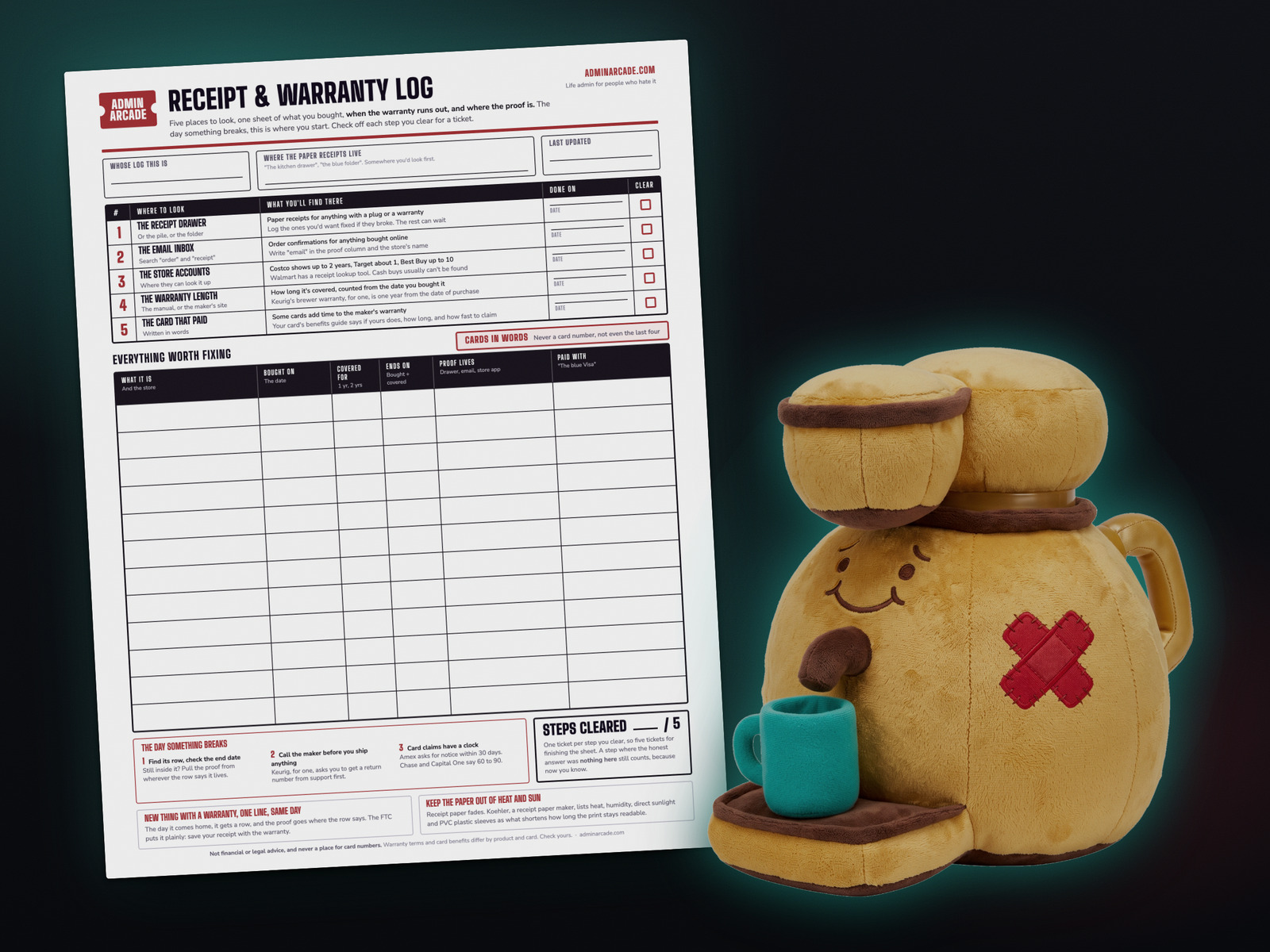
A receipt and warranty log is one sheet of the things you’d want fixed if they broke: what it is, the day you bought it, how long it’s covered, the date the coverage runs out, where the proof is, and which card paid. You fill it from five places, one at a time. When something breaks, the sheet tells you whether it’s still covered and where the receipt went.
The one receipt I didn’t have
So many things of mine have broken. The most recent was a Keurig. The darn thing broke within about a month and a half.
I contacted support and they needed a receipt. Of course I have every receipt in the history of ever, besides that one. I had to eat the loss.
My receipts are paper, in a drawer, and the drawer is a mess. I thought I had them all, which is what made that one so maddening. After the Keurig, I started filing more carefully.
Keurig’s warranty guide for its brewers says “one year from the date of purchase.” Six weeks is a long way inside a year.
Five places to look, one ticket each. Stop after any of them and what you have is still a real list. All five fit inside an admin night.
Why a warranty claim comes down to the receipt
A warranty counts from the day you bought the thing, so the maker needs to see the day. Keurig’s warranty says it will repair or replace a defective brewer “upon its receipt of proof of the date of purchase.” LG’s washer warranty asks you to “retain dated receipt or delivery ticket as evidence of the Date of Purchase.”
The FTC says it plainly: “Save your product receipt with the warranty. The receipt proves the date you bought the product and that you’re the original product owner.”
Without the date, some makers pick one for you. LG’s warranty on three of its TV lines says if the purchase date “cannot be verified, the warranty will begin on the 1st day of the manufacture month.” A TV built months before you bought it starts its clock early.
Registering helps, and none of the warranties quoted here say it replaces the receipt. Keurig recommends registering “so that your purchase information will be stored in our system.” The FTC’s guide for businesses says a full warranty can’t require a registration card. A limited one can, so read which kind yours is.
Step 1: Go through the receipt drawer
Pull out anything with a plug or a warranty you’d want to use if it broke. Not every receipt. Groceries stay in the pile.
Write each one on its own line: what it is, the store, the date, and “drawer” in the proof column. For everything else in the pile, the keep-or-shred sheet says how long each kind of paper needs to stay.
Check the ink while you’re in there. Koehler, a receipt paper maker, says heat, humidity, direct sunlight and PVC plastic sleeves all shorten how long the print stays readable. Keep the drawer away from the stove and the sunny window.
Step 2: Search your email for order confirmations
Anything bought online has a confirmation with the date and the store in it. Search “order,” then “receipt,” then “your order.” Write “email” in the proof column, plus the store’s name so you know what to search for again.
Step 3: Check the store accounts for lost receipts
Some stores can find a receipt you lost, if you paid in a way they can trace. This is the step where a missing one turns up, or doesn’t.
- Costco: your account shows “up to two years’ worth of in-warehouse purchases.” Older than two years, Costco says to ask at the membership desk.
- Target: finds purchases paid with a card saved to your Target.com account, the app Wallet, or a Target Circle phone number, “for up to approximately one year.” Cash, checks and unlinked gift cards can’t be looked up.
- Walmart: has a receipt lookup tool. It asks for the store’s ZIP code or city, the purchase date and total, and the card type and last four digits.
- Best Buy: looks up receipts by the card you used or your My Best Buy account. It can’t retrieve cash or check purchases for non-members, or “purchases made more than ten years ago.”
Found one? Write “store account” in the proof column. The lookup might not be there next year, so print or save the copy now.
Step 4: Find how long each warranty lasts
The manual says, or the maker’s site. Search the model name and “warranty.” Add the length to the date you bought it, and you have the end date.
- Keurig brewers: one year from the date of purchase. Keurig adds another 12 months on its Wi-Fi brewers if you connect through the app at least once every 90 days during the first two years.
- Apple Macs: “ONE (1) YEAR from the date of original retail purchase.”
- LG washers: one year on parts and labor, 10 years on the drum motor, parts only.
When a warranty splits like the LG one, write the shorter number. The one year covers parts and labor. The ten years covers the drum motor’s parts and nothing else. No kind of product here had three makers agreeing on a length, so look yours up instead of assuming.
Step 5: Write down which card paid, and whether it adds time
Some credit cards add time on top of the maker’s warranty. Write the card in words, “the blue Visa,” never the number. Same rule as the autopay list. Then check the card’s benefits guide.
| Card | Extra time, in its own words | Which warranties qualify | How fast to report |
|---|---|---|---|
| Chase Sapphire | “one additional year of coverage” | Three years or less, “up to four years from the date of purchase” | Within 90 days of the failure |
| American Express | “Up to one (1) additional year” | Five years or less | Within 30 days, “or as soon as reasonably possible” |
| Citi Strata Elite | “doubles the time period,” up to 24 months | 24 months or less | Within 60 days |
| Capital One | Depends on the card | Depends on the card | “generally” within 60 to 90 days |
Chase’s general page says the extension “can be an additional year or two,” depending on your lender, card type and item. Chase and Capital One both list the same three documents for a claim: the maker’s warranty, an itemized receipt, and the statement showing the charge on the card you used. The receipt shows up here too.
Extended warranty is one of several card benefits. My hidden perks finder lists the rest for the cards and memberships you already pay for.
Check your dates with Still Covered
Still Covered walks the same five steps. Add what you find, put in how long each warranty lasts, and it hands back every end date, nearest first, with the ones running out in the next 60 days at the top. If your card adds time, it works out the card’s date too, marked unconfirmed until you’ve read the guide.
Nothing you type leaves your browser. There's no account and no server behind it, and it refuses anything with four digits in a row in the item or card boxes.
The printable receipt and warranty log
One page, free, no email required. The five steps across the top with a date line and a check box each, twelve rows for what you find, and the three things to do the day something breaks.
Two rules so the log stays true
New thing with a warranty, one line, same day. The day it comes home, it gets a row, and the receipt goes where the row says it lives. If the drawer is the answer, it's the drawer.
When it breaks, call the maker before you ship anything. Keurig's warranty says: "Please do not return your brewer for servicing without first speaking to Keurig Customer Service to obtain a Return Materials Authorization (RMA) number." If a card might add time, start its clock the same day, because Amex asks for notice within 30 days.
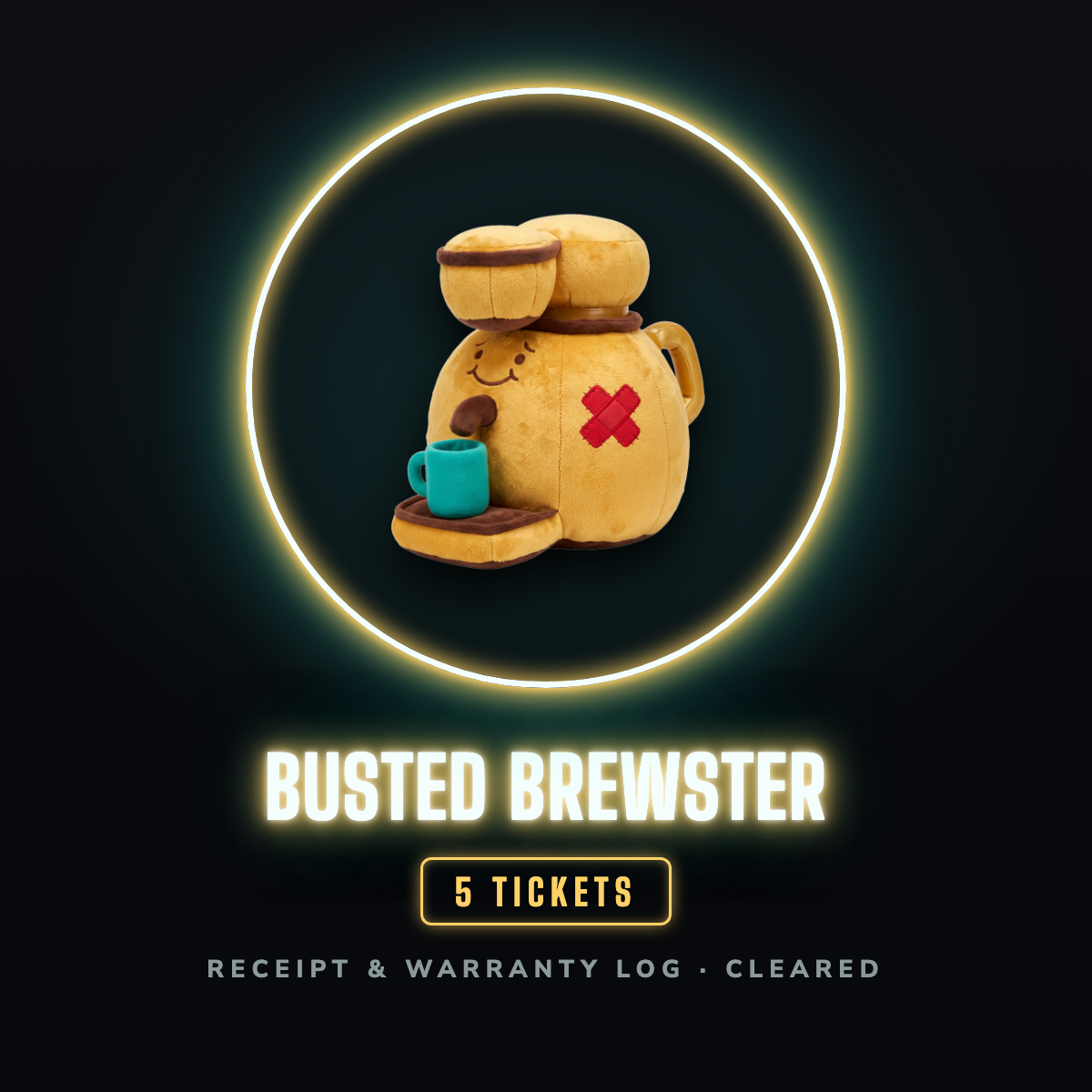
Clear all five steps and you've earned five tickets and Busted Brewster, the prize on this one. Nothing expires and there's no streak to lose, so a log you start tonight and finish next month still pays the same five.
Not financial or legal advice. Every warranty length, card benefit and lookup window above is quoted by name from the company's or agency's own page, and yours will differ. Read your own warranty and your own card's benefits guide.
Frequently asked questions
Do I need a receipt for a warranty claim?
It's the simplest proof of the purchase date, which is what makers ask for. Keurig repairs or replaces a defective brewer upon "proof of the date of purchase," and LG asks you to keep a dated receipt or delivery ticket. The FTC says to save your receipt with the warranty.
Can a store look up a lost receipt?
Some can, if you paid with a card or account they can trace. Costco shows up to two years of warehouse purchases, Target about one year, and Best Buy up to ten years. Walmart's receipt lookup tool asks for the store, date, total and card type.
Do I have to register a product for the warranty to count?
Not for a full warranty. The FTC's guide for businesses says requiring a registration card isn't allowed in a full warranty, but a limited warranty can require one. Keurig says registering stores your purchase information in its system.
Does my credit card extend the warranty?
Some cards do, and the rules differ by card. Chase Sapphire adds one year to warranties of three years or less, American Express adds up to one year to warranties of five years or less, and Citi Strata Elite doubles warranties of 24 months or less. Check your own card's benefits guide.
How long do I have to file a credit card warranty claim?
It depends on the card, and the clock starts when the product fails. American Express asks for notice within 30 days, Citi Strata Elite within 60, and Chase Sapphire within 90. Capital One says generally 60 to 90 days.
Is the printable receipt and warranty log free?
Yes, and there's no email required to get it.
A book I made
Haul to Sold
A take-along sourcing log for resellers. Write down what you paid at the garage sale or thrift store, then fill in what it sold for, the fees and the profit later.
Log your next haul →I run an affiliate program on the tools I build. Approved affiliates earn 20% on what their referrals pay, for up to a year. US only for now. See the program →