Free Grab-and-Go Document Checklist for a Fire or Flood
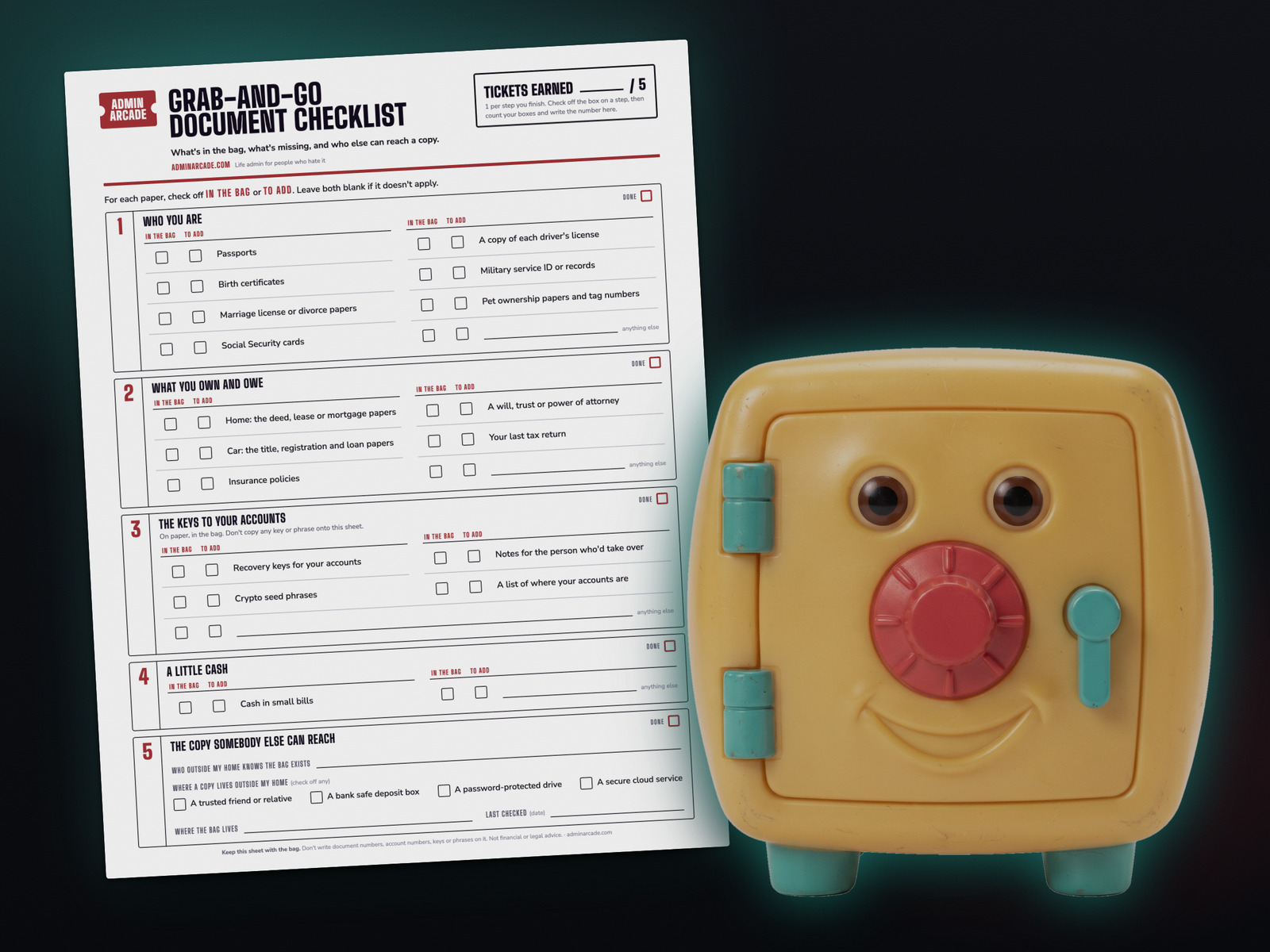
A grab-and-go document checklist is a list of the papers you’d take if you had to leave home fast: IDs and certificates, proof of what you own and owe, the keys to your accounts, and a little cash. Keep them in one fireproof bag, and keep a list of what’s in it. The last step is the one I haven’t done: making sure somebody else can reach a copy. The free printable and tool below cover all five.
A fireproof bag, inside a safe
We have a fireproof bag, and it lives inside the safe. I set it up because I’m a paranoid person, and I like to be prepared. I also think it’s just responsible. Put your important paperwork somewhere safe.
I’ve never had to grab it. Knock on wood.
The bag is the part I like. The big safe isn’t going anywhere, obviously. But we can open the safe and just grab the bag.
What’s safer than a fireproof bag in a safe? Not much, until I think about who else can get into it. Nobody can. So that’s probably a flaw in the system, and it’s step 5 below.
What goes on a grab-and-go document checklist?
Five kinds of things, so there are five steps, one ticket each. Stop after any of them.
- Who you are: IDs and certificates.
- What you own and owe: the house, the car, the insurance.
- The keys to your accounts: recovery keys and the notes for whoever takes over.
- A little cash.
- The copy somebody else can reach.
This post is only the bag. If you’re facing a whole pile and deciding what to keep at all, start with how long to keep paperwork, then come back with the keep-forever stack.
Most of the list comes from FEMA’s guide, Safeguard Critical Documents and Valuables. It’s three pages. Step 3 is mine.
No bag yet? I reviewed a fireproof document holder with a lock on Jen Tried It, and the review has its own tool for working out which papers apply to your life.
Step 1: Which IDs and certificates go in the bag?
Ours has our passports, our birth certificates, and our marriage license.
FEMA’s list for this part is “vital records (birth, marriage, divorce certificate, adoption, child custody papers)” and “passport, driver’s license, Social Security card, green card, military service identification.” Your license lives in your wallet, so a photocopy is what goes in the bag.
It also lists “pet ownership papers, identification tags.” If your pet’s microchip number is already on a pet records sheet, a copy of the sheet covers it.
Step 2: What will an insurer or FEMA ask you for?
FEMA’s reason for this step: “you will need documentation to request assistance from insurance providers and from government disaster assistance programs.” Here’s what its guide lists.
| For | What FEMA lists |
|---|---|
| Housing | Lease or rental agreement, mortgage, home equity line of credit, deed |
| Vehicle | Loan documents, VIN, registration, title |
| Insurance policies | Homeowners, renters, auto, life, flood, appraisals, photos, and lists of valuable items |
| Tax statements | Federal and state income tax returns, property tax, vehicle tax |
| Estate planning | Will, trust, power of attorney |
There are some other important documents in my bag, and sitting here I can’t tell you what they are. A contents list fixes that, and it’s what the tool prints at the end.
Step 3: Recovery keys, seed phrases, and the notes for whoever takes over
This step is from my bag. FEMA’s guide skips it.
Mine has our crypto seed phrases. It also has recovery keys, and those aren’t only a crypto thing. Some other accounts give you recovery keys when you set them up, so I put those in there too.
Before I had surgery, I wrote up a whole bunch of stuff my husband should know. That whole thing is in the bag now. If you don’t have one yet, the account list is where I’d start.
These stay on paper, in the bag. The checklist and the tool only ask whether you have them. Don’t type a key or a phrase into this tool or anybody else’s.
Step 4: Should you keep cash in the bag?
There’s a little bit of cash in mine. Ready.gov says to “keep a small amount of cash at home in a safe place,” in small bills, because ATMs and credit cards “may not work during a disaster.” It doesn’t name an amount, and I won’t either.
Step 5: Who else can reach a copy?
For us, nobody. If my husband and I can’t get to the safe, there’s no copy anywhere else, and we haven’t told anyone the bag exists. Well, besides all of you now. lol
FEMA’s guide gives three places for paper copies. Its words: “Consider storing paper copies of important documents at home in a fireproof and waterproof box or safe, in a bank safe deposit box, or with a trusted friend or relative.”
I have the first one and neither of the other two.
- A trusted friend or relative. At the least, one person outside your house who knows the bag exists.
- A bank safe deposit box. FEMA adds a caution: “ask your bank or check state laws to confirm who can and cannot access the safe deposit box if the lessee dies or is incapacitated.”
- Electronic copies. FEMA says to keep them “in a password-protected format on a removable flash or external hard drive in your fireproof and waterproof box or safe, or consider using a secure cloud-based service.”
Copies are for the certificates and the policies. The keys from step 3 are a different decision, and it’s yours to make.
Check your bag with the tool
The tool walks the same five steps. Mark each paper as in the bag, need to add, or doesn’t apply. At the end you get three lists: what’s in the bag, what’s still to add, and who outside the house can reach a copy. Print it and keep it with the bag.
Your check saves in your own browser, so you can come back on the same device. There's no account and no server behind it, "Erase everything" wipes it, and it never asks for a number, a key or a phrase.
The printable grab-and-go document checklist
One page, free, no email required. All five steps, with two boxes next to every paper: one for "in the bag" and one for "to add." Step 5 has a line for who knows the bag exists and a spot for the date you last checked.
Two rules so the bag stays right
The list stays with the bag. When something goes in or comes out, fix the list while the bag is still open.
The list names things. It doesn't copy them. "Seed phrases, in the bag" is fine. The phrase itself never goes on the sheet.
If your bag is still mostly a plan, finding the documents for it is one of the four stations on an admin night.
Finish all five steps and you've earned five tickets and Vault Walt, the prize on this one. Nothing expires and there's no streak to lose, so a checklist you start today and finish next week still pays the same five.

Not financial or legal advice. This checklist tracks what's in your bag. It doesn't tell you what you're required to keep.
Frequently asked questions
What documents should I grab in an emergency?
FEMA's guide groups them as household identification, financial and legal documentation, and medical information. In practice, start with IDs and certificates, then proof of what you own and owe, then insurance policies.
Where should I keep important documents at home?
FEMA says to consider a fireproof and waterproof box or safe at home, a bank safe deposit box, or a trusted friend or relative. A bag inside a safe gives you one thing to carry out.
Should I keep cash with my important documents?
Ready.gov says to keep a small amount of cash at home in a safe place, in small bills, because ATMs and credit cards may not work during a disaster. It doesn't name an amount.
Who should have copies of my important documents?
FEMA's guide names a trusted friend or relative, or a bank safe deposit box. For a safe deposit box, it says to ask your bank or check state law about who can open it if you die or are incapacitated.
Is the printable grab-and-go document checklist free?
Yes, and there's no email required to get it. It's one page, and the tool on this post is free too.
A tool I built
Emergency Fund Aquarium
Log what you save at your own bank and watch your tank fill with creatures. Your money never moves through the app.
Start your tank →I run an affiliate program on the tools I build. Approved affiliates earn 20% on what their referrals pay, for up to a year. US only for now. See the program →